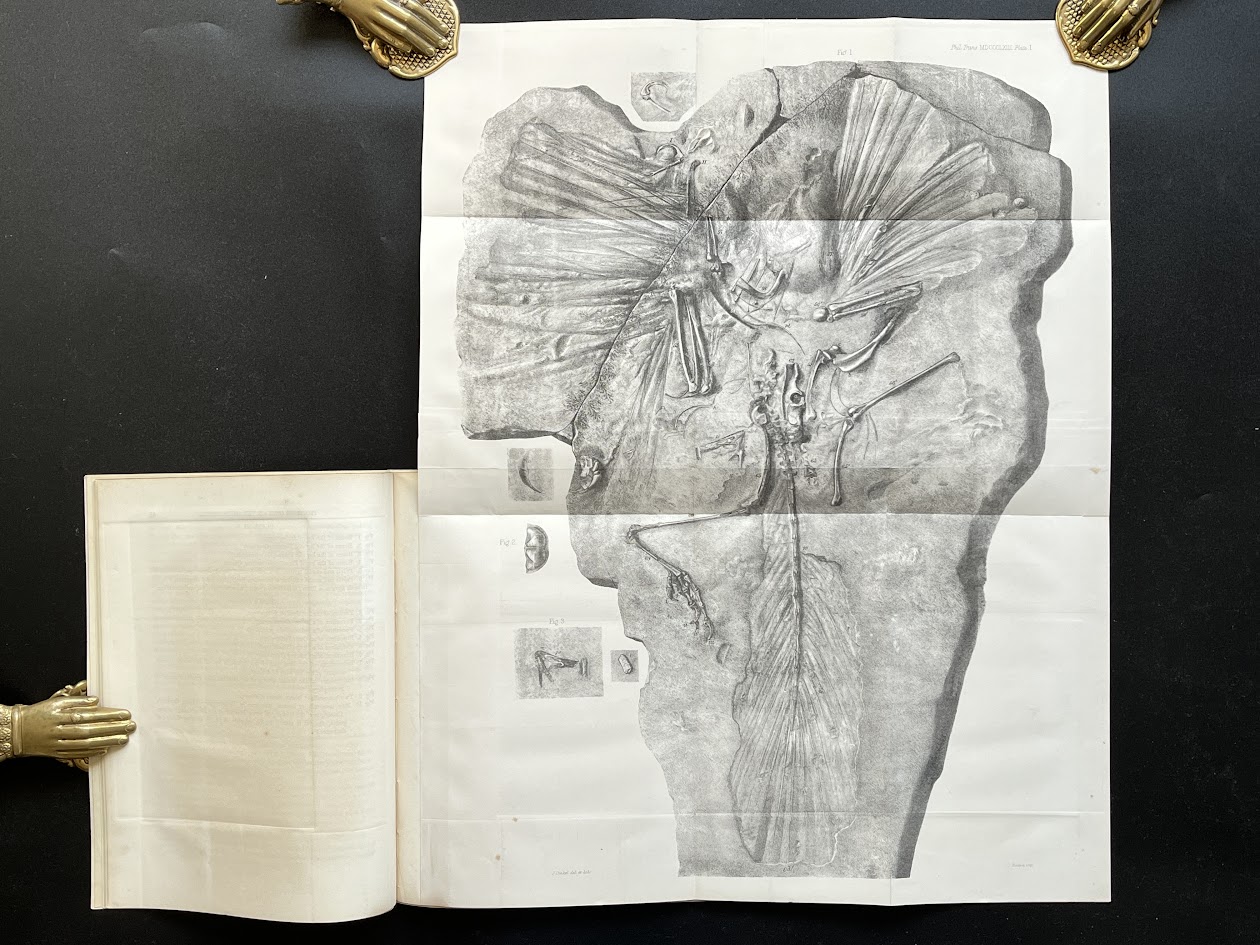
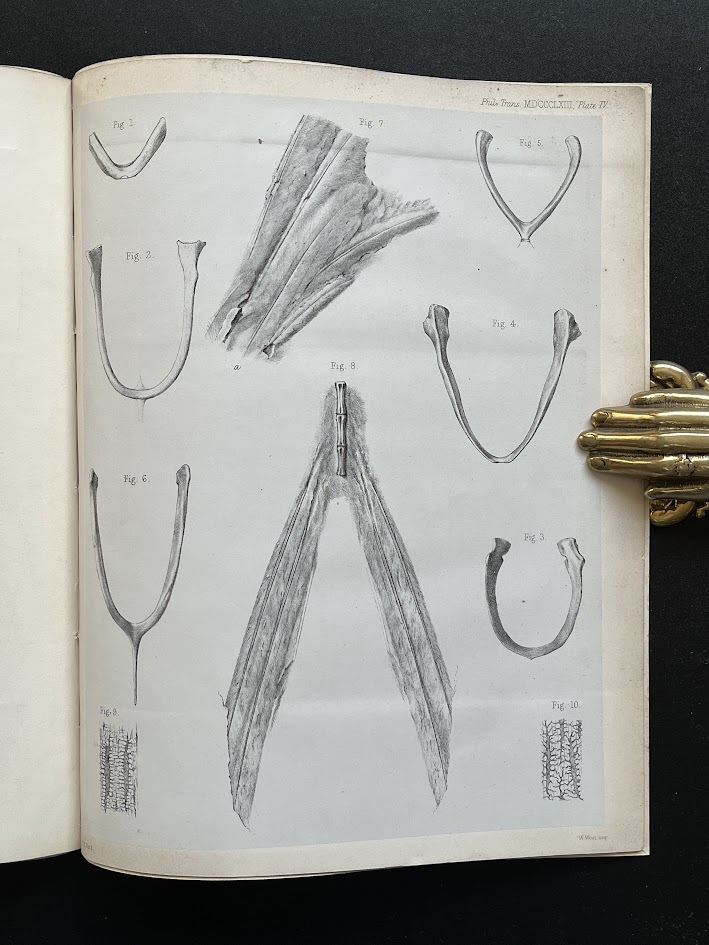
The first published description of Archaeopteryx, one of the most significant fossils ever discovered. This is Richard Owen's classic Philosophical Transactions paper, illustrated with an exceptional lithographic folding plate showing a life-sized image of the type specimen.
The first glimpse of Archaeopteryx occurred in 1861, when a single feather was illustrated in a German periodical. Soon an entire skeleton was found nearby, and this was purchased for the high price of £700 by the British Museum (Natural History).
This was the first hint that birds or their ancestors might have lived in the time of the dinosaurs. The renowned anatomist Owen wasted no time in preparing his account of the specimen: his paper was read to the Royal Society on 20 November 1862, and published a year later. Owen had earlier coined the term 'dinosaur', but nevertheless remained certain that Archaeopteryx was an early bird, unrelated to dinosaurs. This was a reflection of Owen's cautious and anti-Darwinian approach to evolution, and his search for morphological archetypes. However, others immediately saw the possibility that Archaeopteryx was a 'missing link' in the evolutionary chain.
In the fourth edition of On the Origin of Species, for example, Charles Darwin wrote that some have maintained, that the whole class of birds came suddenly into existence during the eocene period; but now we know, on the authority of Professor Owen, that a bird certainly lived during the deposition of the upper greensand; and still more recently, that strange bird, the Archaeopteryx, with a long lizard-like tail, bearing a pair of feathers on each joint, and with its wings furnished with two free claws, has been discovered in the oolitic slates of Solnhofen. Hardly any recent discovery shows more forcibly than this how little we as yet know of the former inhabitants of the world.
As Darwin hinted, Archaeopteryx was to remain highly controversial for many decades, and is one of the
most studied of all fossils. Decisive work on the evolution of birds by John Ostrom in the 1960s and
1970s led to a consensus that birds did indeed evolve from dinosaurs – reviving an idea first voiced by
Huxley in the 1860s. In this new paradigm Archaeopteryx is placed in the dinosaur clade Theropoda. We
are now in possession of many earlier and later ancestors of birds, and many dinosaurs are thought to have
been feathered. To date only 12 specimens of Archaeopteryx have been discovered.
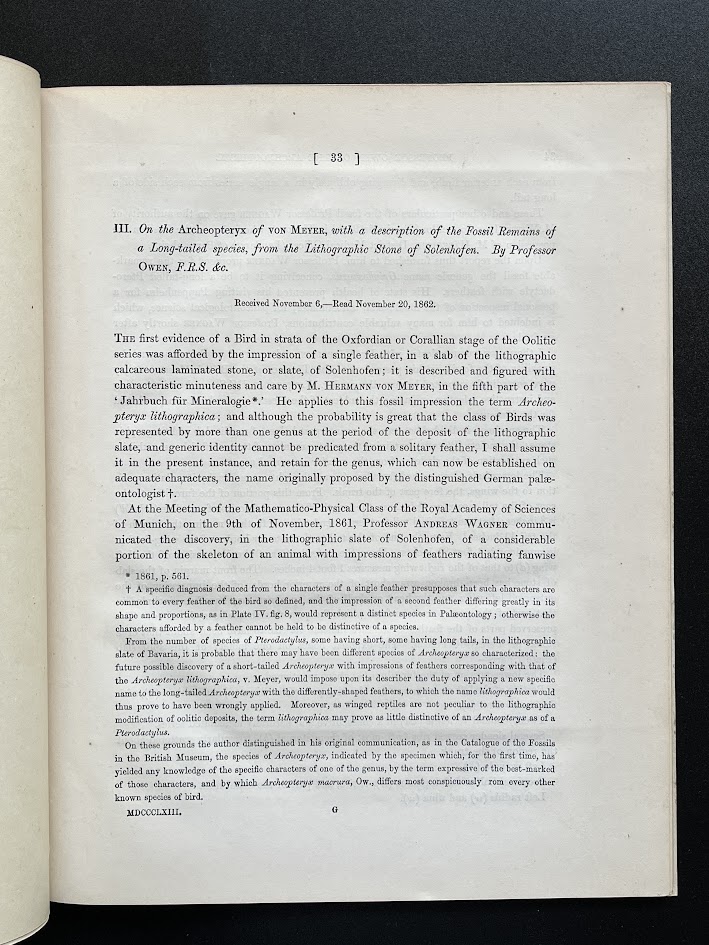
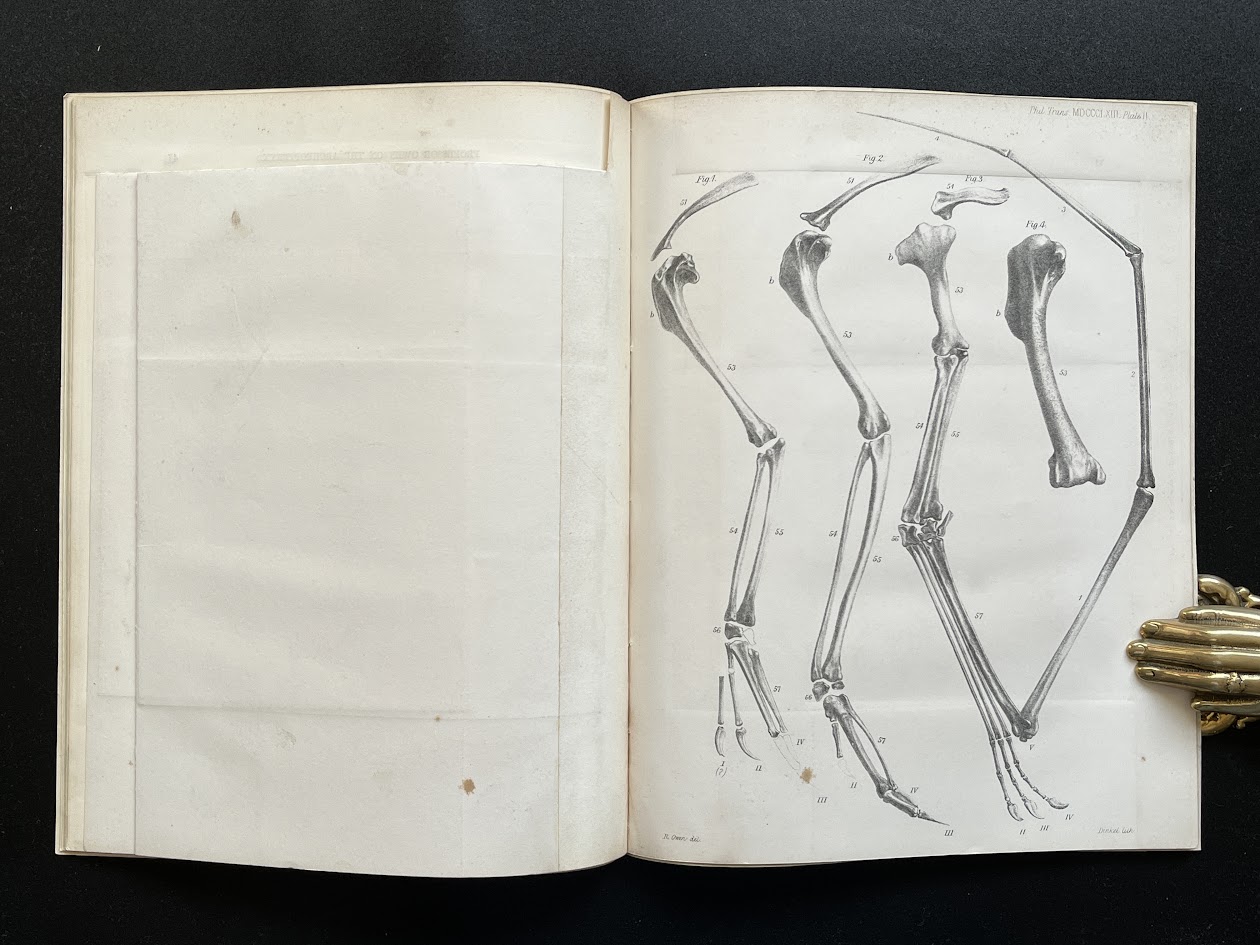
DESCRIPTION: On the Archeopteryx of von Meyer, with a description of the Fossil Remains of a Long-tailed species,
from the Lithographic Stone of Solenhofen. In Philosophical Transactions, Vol. 153 (1863), pp. 33–47, 4 lithographic plates. Antique marble paper wrappers, recently bound. A near fine copy with the slightest spotting to a couple of pages only.