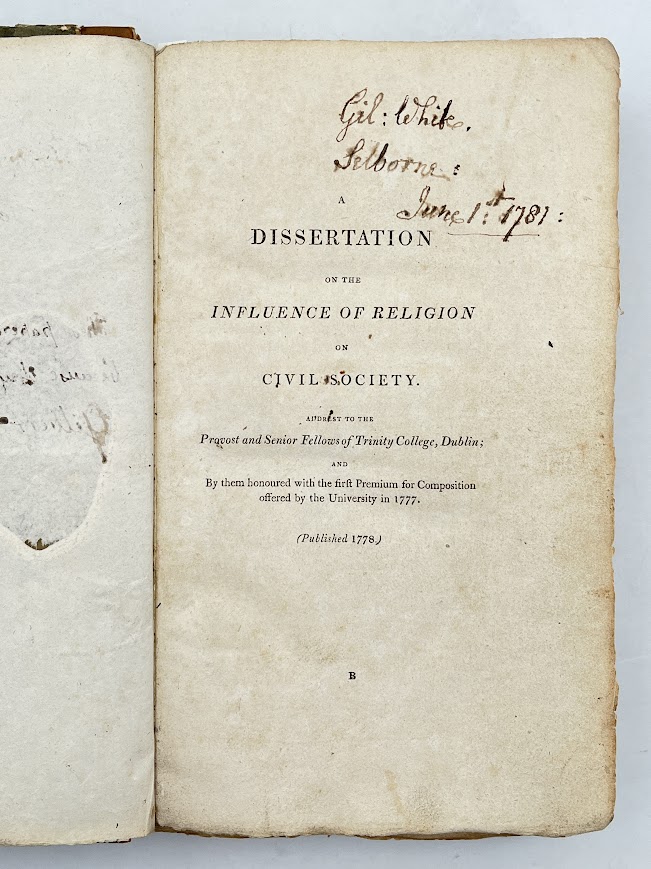
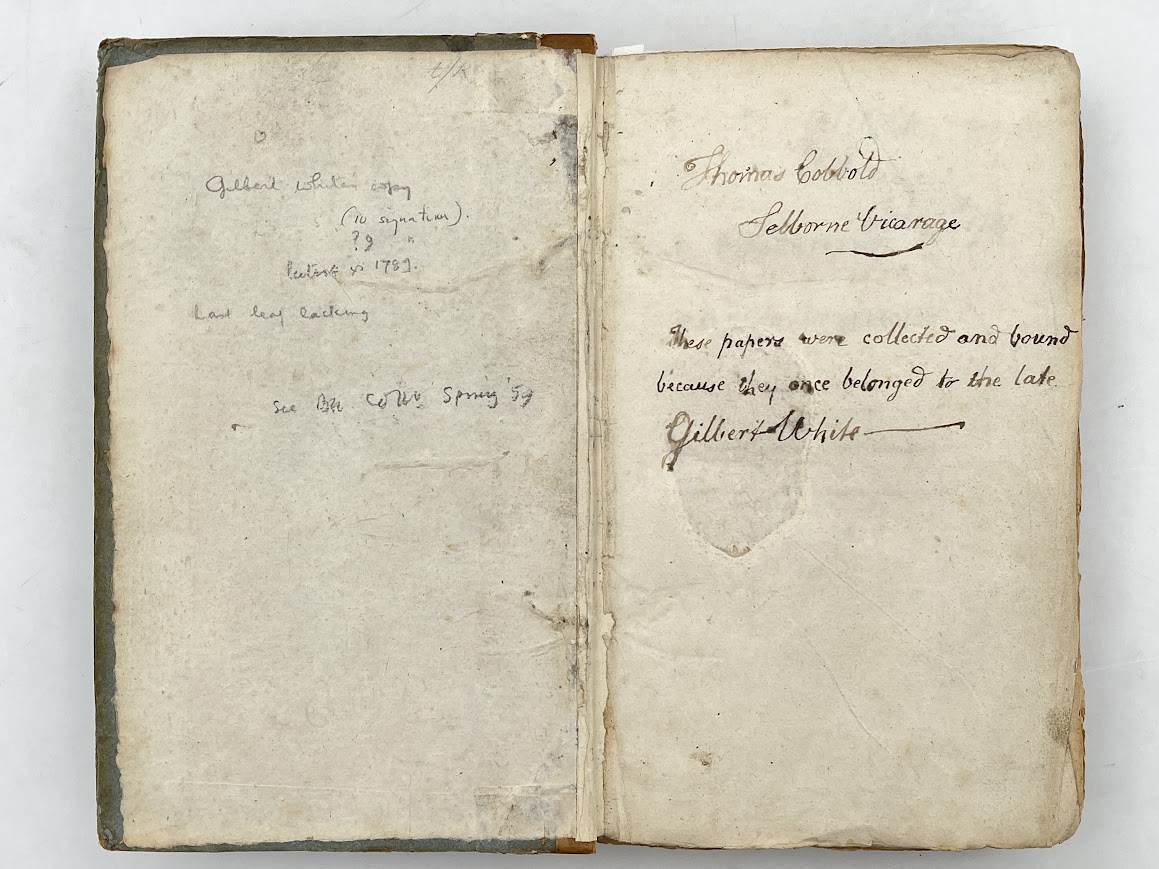
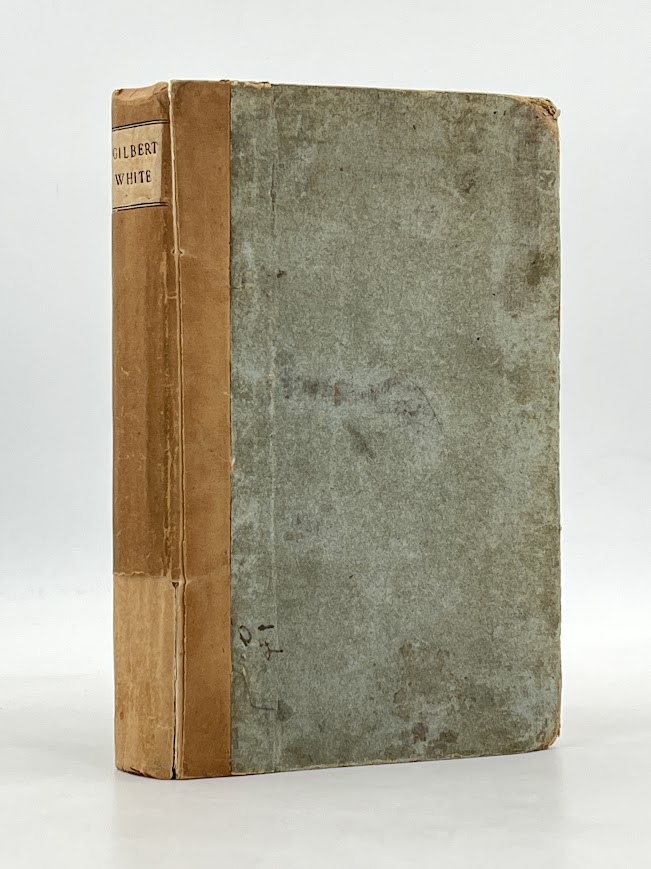
A sustained and outrageous forgery purporting to be a collection of essays individually owned, inscribed and in places even annotated by the naturalist and writer Gilbert White. The fictitious chain of provenance has the book being owned by White’s successor at Selborne, the vicar Thomas Cobbold who has supposedly written on the flyleaf that ‘These papers were collected and bound because they once belonged to the late Gilbert White-’ Certainly there are 10 supposed ownership signatures belonging to White scattered through the text but this is a patent fiction. The purported collection of essays is actually a single publication by John Robert Scott dating from 1804 - a decade after White’s death and his ownership is an impossibility. However the forger has certainly had access to specimens of White’s handwriting and he (surely?) has done a respectable job at recreating the naturalist’s hand in old age. In order to avoid detection the forger has also removed the book’s preliminaries and other dated leaves to create a deceptive image of separately produced essays as well as adapting the original binding. Tentatively we suggest that the forgery was executed around 1900.
GILBERT WHITE was born at the vicarage, Selborne, Hampshire in July 1720, eldest son of John and Anne White. He stayed in his paternal grandfather’s Selborne house all his life, finally publishing The Natural History and Antiquities of Selborne close to the end of his life in 1789. Books from Gilbert White’s library are rare in commerce and institutionally held, examples such as the Whipple Library’s copy of John Ray’s Synopsis, formerly owned by Gilbert White and Pope’s translation of Homer, presented by him to White, and now in the BL, are few and far between.
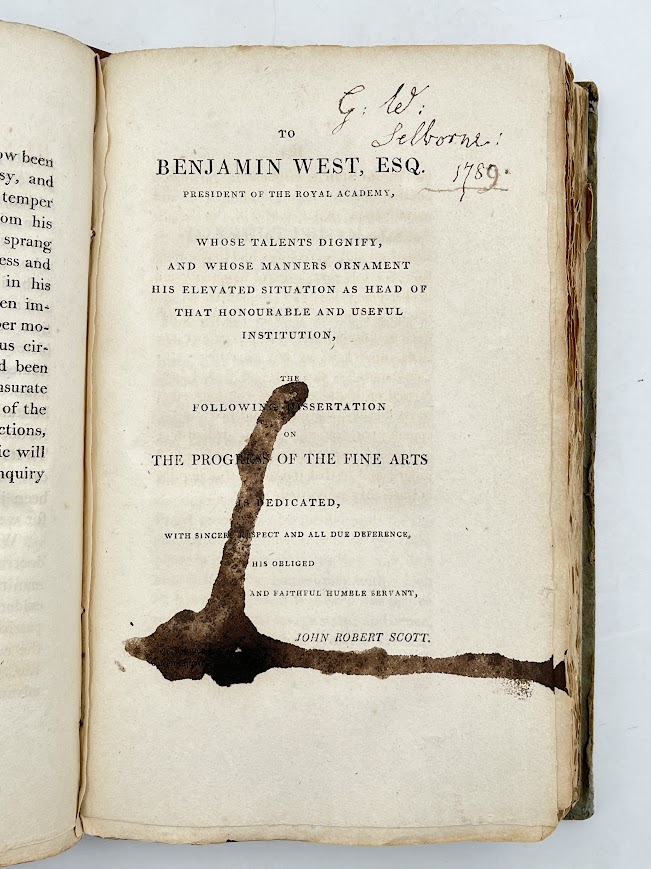
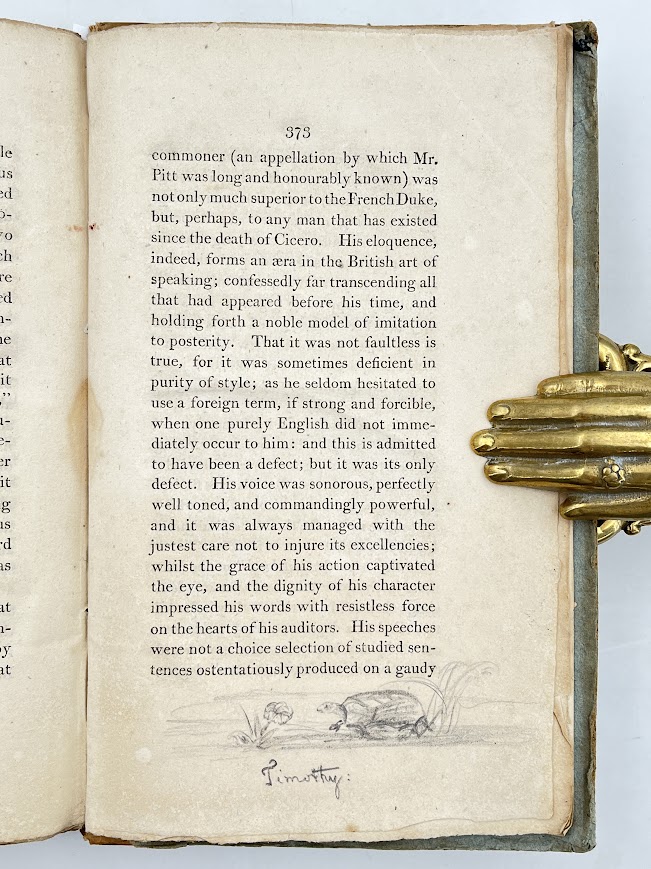
DESCRIPTION: Original blue paper covered boards with a later fragmentary paper spine and ‘Gilbert White’ printed label. New flyleaf with the inscription: ‘Thomas Cobbold Selborne Vicarage - These papers were collected and bound because they once belonged to the late Gilbert White-’ The six preliminary leaves have been removed as they would immediately have revealed the deception; instead the book starts on page 1, B1 with Scott’s Dissertation on the Influence of Religion on Civil Society’, purportedly inscribed: ‘Gil: White, Selborne: June 1st: 1781’. Subsequent essays are ‘signed’ sequentially by White through September 1781 in a variety of ways; a leaf has been removed before the essay dedicated to Benjamin West, presumably because it too was dated after White’s death. The ‘Comparison of Henry IV of France and William III of England’ is inscribed to the title page with a further annotation purporting to be in White’s hand: ‘Henry promulgated the Edict of Nantes April 13th 1598. Gilb.t’ with the revocation noted at the beginning of the next essay. A pencil drawing of a tortoise called ‘Timothy’ sits at the foot of p373 - also perhaps intended to be in White’s hand? The text ends on p380, lacking the final leaf which also, no doubt, was dated. Laid in is a puzzled note by a previous owner, a noted Gibert White collector, trying to make sense of the book’s contradictory provenance.