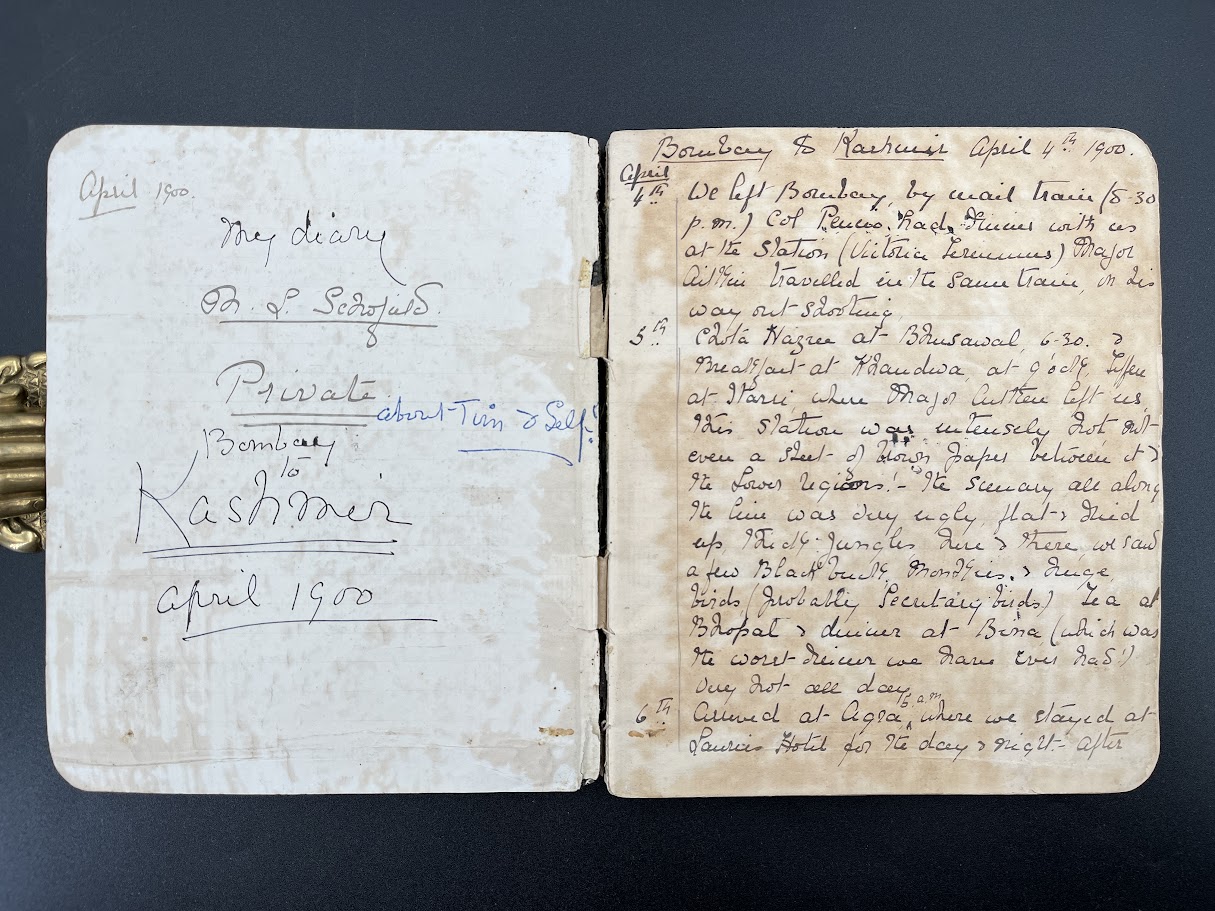
My Diary R L Schofield Private: Bombay to Kashmir April 1900
Schofield’s journal starts in British colonial Bombay society but the traveller found himself fascinated by indigenous peoples and their communities and occupations, as well as the architecture and agriculture of the regions he travelled through with their ever changing landscapes from the Arabian Sea coast to the lakes, wooded valleys, and snow-covered Himalayan peaks of Kashmir.
The diary follows Schofield's journey from Bombay to Agra, where he visited the Taj Mahal, the tomb of Itimad-ud-Daulah and the Fort. Travelling northwards by railway through Ghaziabad and Ambala, he continued to Rawalpindi before undertaking a 165-mile journey by tonga towards Kashmir, passing through Tret, Murree, Kohala, Domel, Uri and Rampur to Baramulla. There the party boarded a houseboat for Srinagar via Sopore, subsequently exploring Dal Lake, the Mughal gardens of Nishat and Shalimar, Shadipur and Wular Lake, before venturing into the Lidder Valley and the mountains around Pahalgam. Among the individuals mentioned are Oliver Goldsmith, possibly the Royal Indian Marine officer who later became Captain and Port Officer at Calcutta, and Captain Bryan Gordon, later commander of the R.I.M.S. Clive, alongside Major Prescott, Captain Phillips, Major Carr and Schofield's travelling companion Tim.
DESCRIPTION: Original manuscript diary in black textured cloth over boards, written in English, predominantly in ink, on the ruled leaves of a notebook, generally occupying the recto of each leaf only, with the versos largely left blank. The dated entries form a continuous personal account of the journey, interspersed with photographic sections and occasional manuscript annotations. Small quarto (22 x 16 cm) [pp] 40 manuscript, [43] albumen and gelatine silver photographs with captions.
The photos, of various dimensions (17x13 cm to 5x3 cm), are arranged singly or in groups of two, four, or six upon the notebook leaves. They are generally secured by inserting their corners into diagonal slits cut directly into the paper, rather than being pasted down, and are frequently accompanied by handwritten captions identifying people, places, vessels, buildings, activities, and incidents encountered during the journey. Some photographs additionally bear handwritten dates, initials, or photographic attributions. The volume additionally contains an original photographic postcard entitled “Sweetmeat”, a preserved botanical specimen mounted on a separate sheet, and a folded personal letter in blue ink, signed “Helen”. A later newspaper cutting from the Western Morning News, dated 22 May 1972, relating to the British Mycological Society, is also preserved within the volume. Further manuscript notes, including names, places, and references to woodcarvers in Srinagar, appear on the rear pastedown. Four photographs have been removed, leaving their original handwritten captions and mounting traces, captioned “Plague Disinfecting”, “Kitchen”, “Getting the Toddy”, and “Red Rose”; rubbing and losses to the cloth along the spine, exposing the underlying boards, at the spine end, lower spine, and frayed, foxing on the first and last pages. Overall, a very good illustrated diary.
NARRATIVE:
The diary opens with Schofield's experiences in Bombay, where he records the activities of the British naval and civilian community, excursions around the harbour, and visits to nearby places of interest. Accompanying photographs introduce several members of his circle, including Captain Gordon and Oliver Goldsmith of the Royal Indian Marine. Views of the R.I.M. Clive in Bombay Harbour, the Yacht Club, and Watson's Annexe appear alongside informal portraits, fishing boats, and excursions aboard the Red Roe. Other photographs show the party travelling to Manach Fort and returning to their boat, while a series taken around Vehar Lake includes a picnic scene bearing the annotation “Photo taken by me!”. The Bombay photographs also record aspects of Indian urban life, including a dancing girl, a hay cart, dockside activity, and an original photographic postcard entitled Sweetmeat, depicting local vendors. Particularly arresting is a photograph captioned “Plague”, showing a local man lying on the ground with other people nearby; a second image, entitled “Plague Disinfecting”, is now missing, although its original caption survives.
By early April, Schofield had reached Agra, where he visited the tomb of Itimad-ud-Daulah, crossing the Jumna by a pontoon bridge whose uneven roadway he compared to “a Switch Back”. He describes the marble decoration of the tomb before proceeding to the Taj Mahal, its gardens and inlaid ornament, and subsequently to Agra Fort. There he explored the Pearl Mosque, the palace apartments, and the former harem, admiring the mirrored decoration of the bathroom and the extensive red sandstone fortifications. He also visited the local marble workshops, purchasing several small objects.
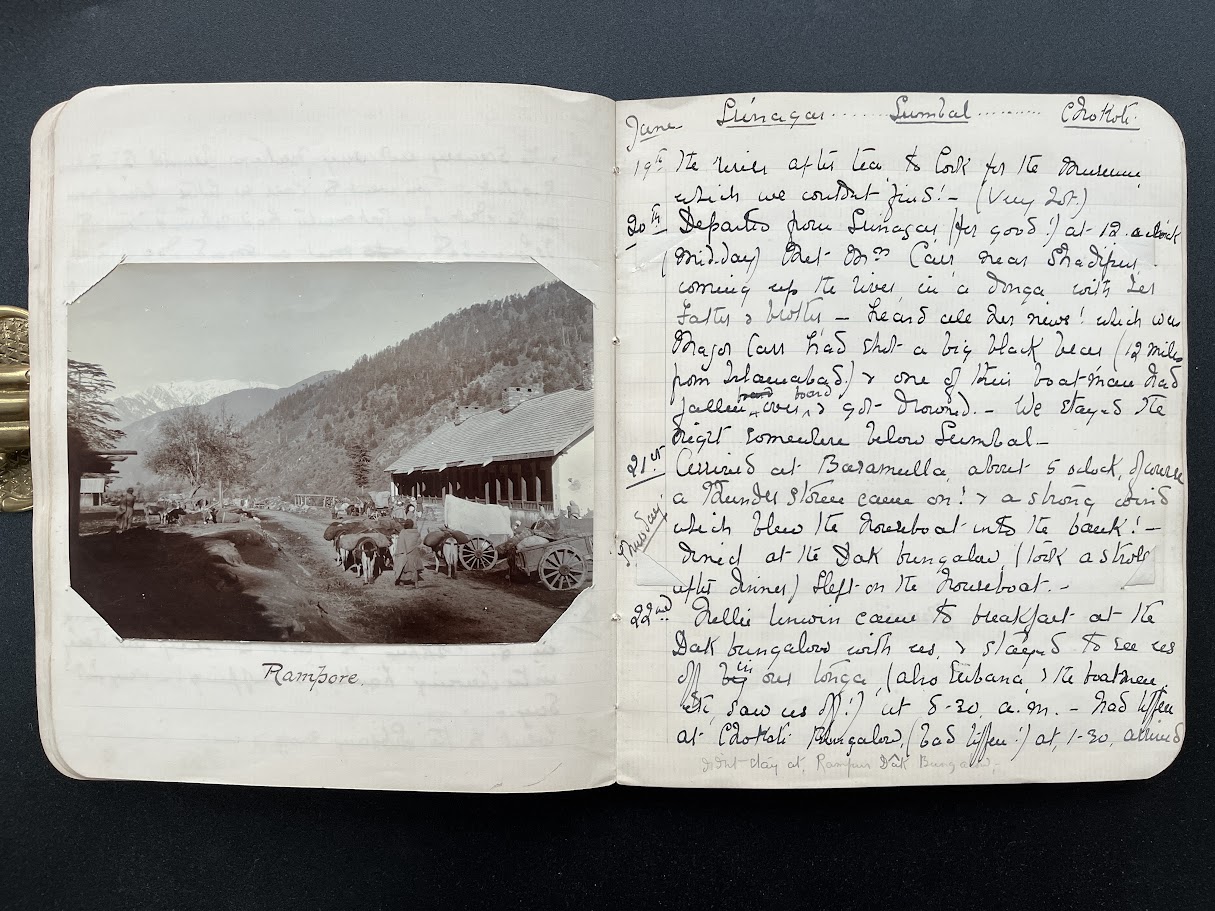
On 7 April, Schofield left Agra by the early morning mail train, travelling through Ghaziabad and Ambala, where he encountered Major Prescott. The journey was interrupted by the discovery that a thief had entered the railway carriage and stolen his jewellery and eight silver rupees. Continuing through Lahore amid thunderstorms and hail, he reached Rawalpindi on 8 April, staying at Flashman's Hotel before beginning the 165-mile tonga journey towards Kashmir the following afternoon. His luggage, equipment, and cook followed in nine ekkas, a form of horse-drawn carriage illustrated by a contemporary photograph captioned “Ekkas near Rampore”. Another photograph, simply entitled “a tonga”, shows the covered conveyance used on the mountain roads.
The journey towards Murree proved exceptionally difficult. Heavy rain, deep mud, snow, and obstructed roads repeatedly delayed the travellers, while bullock carts and a passing mule battery further complicated their progress. At Murree, Schofield encountered snow several inches deep and bitterly cold conditions, finding welcome shelter beside a large fire. The road towards Kohala descended through fir forests and steep mountain scenery, but landslips caused by the rains made several sections dangerous. Huge stones had fallen across the road, forcing the party to dismount and walk.
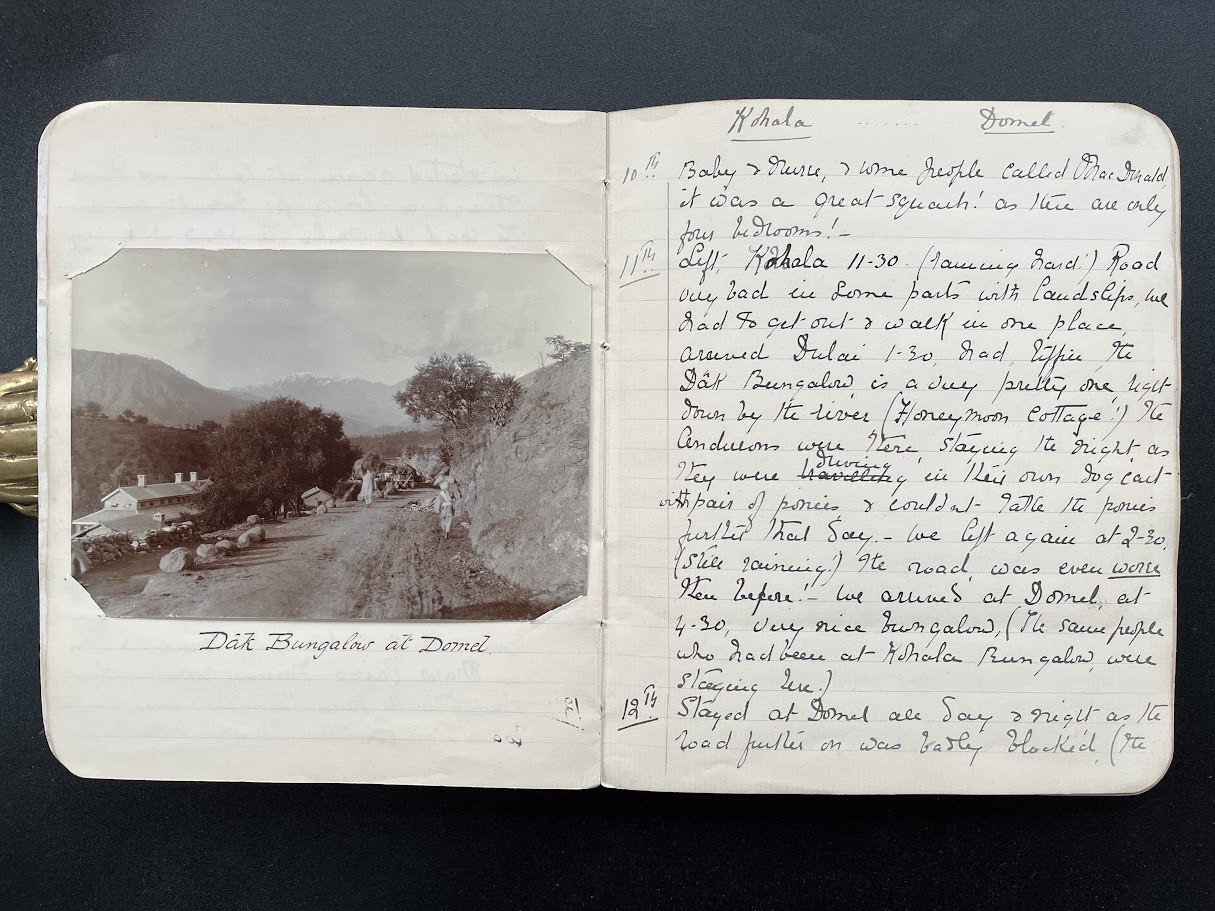
The difficulties continued along the Jhelum Valley Road. Between Domel, Uri, and Rampur, Schofield describes sections where the road had collapsed into the river, leaving a narrow passage beneath overhanging cliffs. At one particularly dangerous point, the ponies were led across separately and the carriage pulled over by hand. The diary also describes rope bridges spanning the river near Chakoti and Uri, one of which sagged so low that its centre touched the water when the river was high. An accompanying photograph captioned “Gurhi Swing Bridge” records one of the region's precarious river crossings, while views of the dak bungalow at Domel and the mountain settlement of Rampore illustrate the stopping places along the route.
Arriving at Baramulla on 14 April, Schofield boarded a houseboat and began the river journey towards Srinagar. Snow-covered mountains surrounded the valley, while orchards in full blossom lined the riverbanks. The following day, Easter Sunday, the party reached Sopore, where Schofield observed the mosque of Shah Hamadan and described the village's buildings.
During his stay in Srinagar, Schofield explored the town, its shops, and the local silk factory, paying particular attention to Kashmiri woodcarving and papier-mâché work. He visited the Residency and climbed to the temple of Takht-i-Suleman, overlooking Dal Lake and the Jhelum, a view accompanied by a photograph bearing the same name. Excursions by small boat took him through the canals and floating gardens of Dal Lake, where he observed cultivated beds anchored by poles to prevent them drifting away. He also visited the Mughal gardens of Nishat and Shalimar, describing their terraces, fountains, waterfalls, great chenar trees, and marble architectural features. The diary records the purchase of decorative objects from a merchant known as “Suffering Moses”, who subsequently delivered the ordered papier-mâché work to the houseboat.
The manuscript is accompanied by photographs of the houseboat on Wular Lake, a boy fishing, and the agricultural land around its shores. The party's movements were frequently interrupted by rain, strong winds, and thunderstorms, while the diary also records the beauty of the lakeside vegetation, including wild irises, tulips, and flowering trees.
In mid-May, the party organised a bear hunt after learning that an animal had killed cattle in the surrounding countryside. On 13 May, Schofield and his companions set out with a local guide named Subana and some fifty “coolies”, who were employed to beat through the jungle and drive the animal towards the hunters. The expedition involved a long ascent in intense heat through thick vegetation and steep mountain paths, although the hunters eventually returned without securing the bear. Further excursions including another difficult pursuit on 16 May, when heavy rain and darkness made the return journey hazardous. The ponies struggled on the slippery tracks, Tim fell from his mount, and Schofield was forced to dismount when his own pony could no longer negotiate a steep hillside. The party eventually returned at nine o'clock, soaked and exhausted, to a large wood fire and dinner.
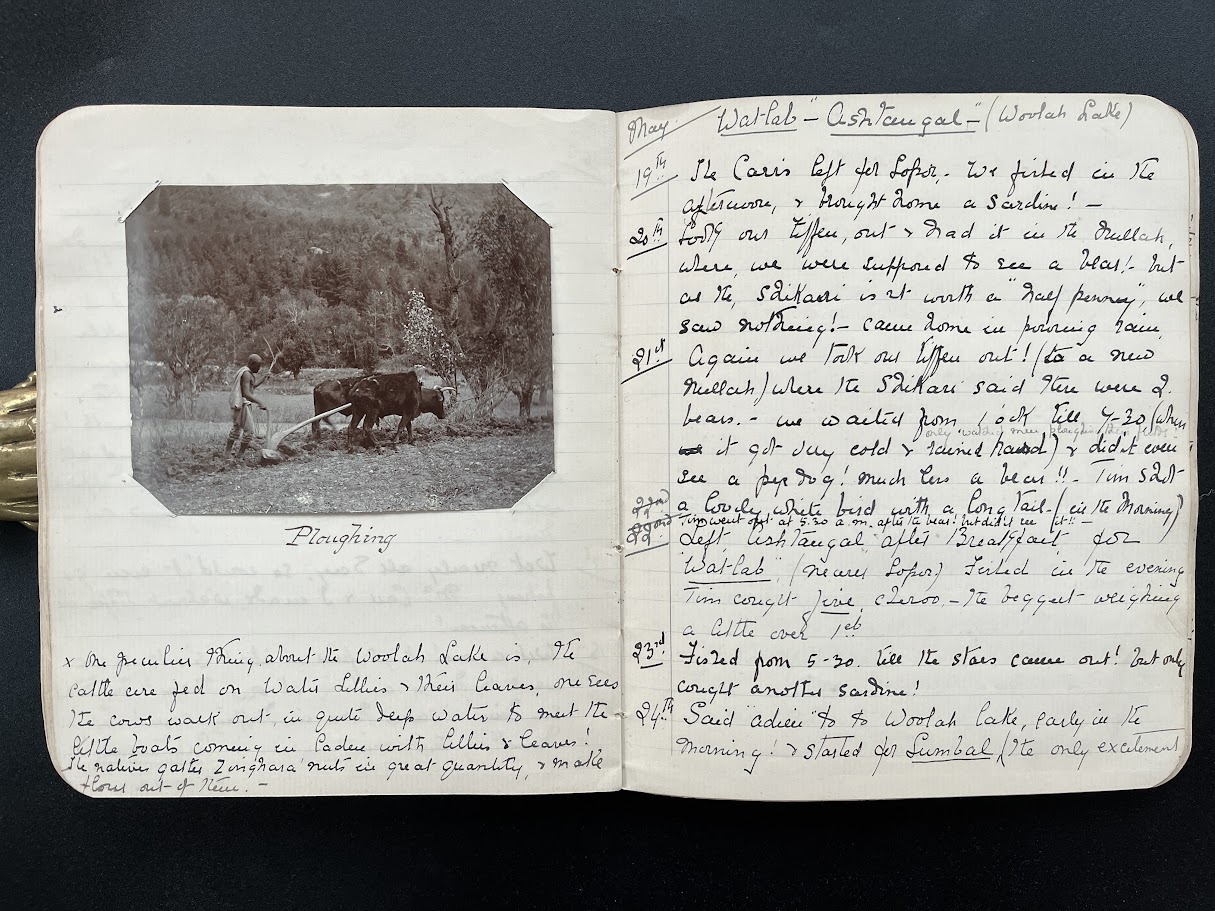
After further fishing and excursions around Wular Lake, Schofield returned towards Srinagar in late May, passing through villages and cultivated countryside. An accompanying photograph captioned “Ploughing” shows a local farmer working with cattle, while other images document boats, settlements, and the landscape along the waterways. At the end of the month, the party left Srinagar for Islamabad and Bijbehara, continuing into the Lidder Valley in early June. Their expedition involved ponies, servants, porters, and camping equipment, with photographs illustrating the mountain villages, streams, and the great snow-covered peaks of the valley. The ruins of Martand, identified in a manuscript caption as the “Temple of the Sun”, are also represented, together with views of Pahalgam and Kolahoi.
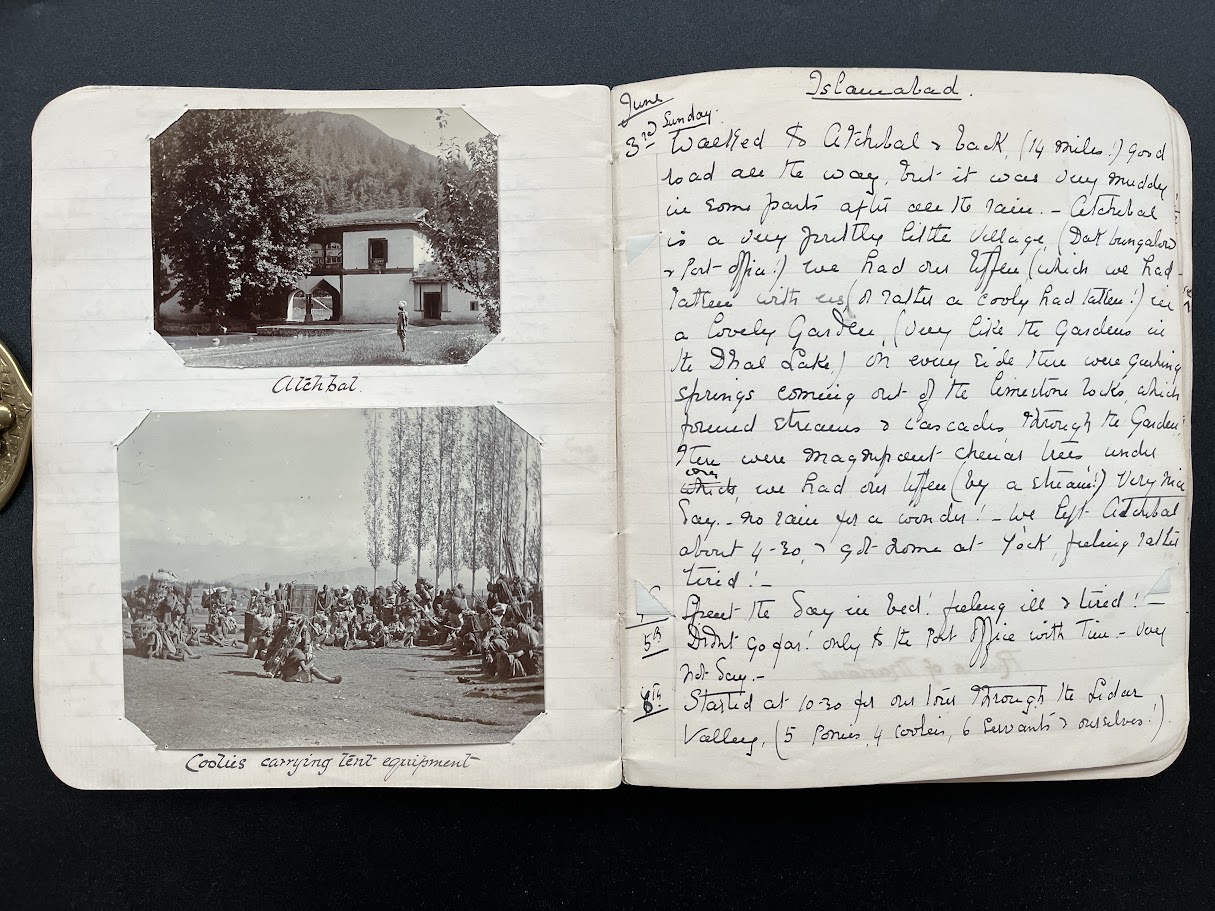
Schofield's descriptions of the Lidder Valley combine fishing expeditions, mountain walks, and further attempts to hunt bears. On 13 June, the party camped beneath walnut trees near a small temple, their baggage and tents having been carried by twelve coolies when ponies were unavailable. The following morning, another bear hunt took place with forty local men beating through the mountain vegetation. After several unsuccessful drives, a large bear appeared on the opposite slope, and Tim fired, wounding the animal, which escaped into the mountains. The hunters abandoned the pursuit as darkness approached, leaving the local shikaris to search for it. A photograph captioned “Coolies on the march” shows local porters carrying substantial loads across a wooden bridge, illustrating the labour required to move the travellers' equipment through the mountains.
The same pages contain an extensive list of wildflowers observed during the journey, including roses, jasmine, irises, clematis, poppies, violets, buttercups, honeysuckle, and water lilies. Schofield also records collecting butterflies during walks through the forests. Two preserved botanical specimens accompany the manuscript, providing physical examples of the natural history material associated with the expedition.
The return journey towards Rawalpindi brought further thunderstorms, uncomfortable dak bungalows, and long stages by tonga. At Murree, the travellers stayed at the Victoria Chambers, where a band played at the club after dinner. Descending towards Rawalpindi, Schofield encountered numerous camels along the road before reaching Flashman's Hotel.
The diary closes with the travellers' arrival in Bombay on 27 June, exhausted by the heat and the long journey.