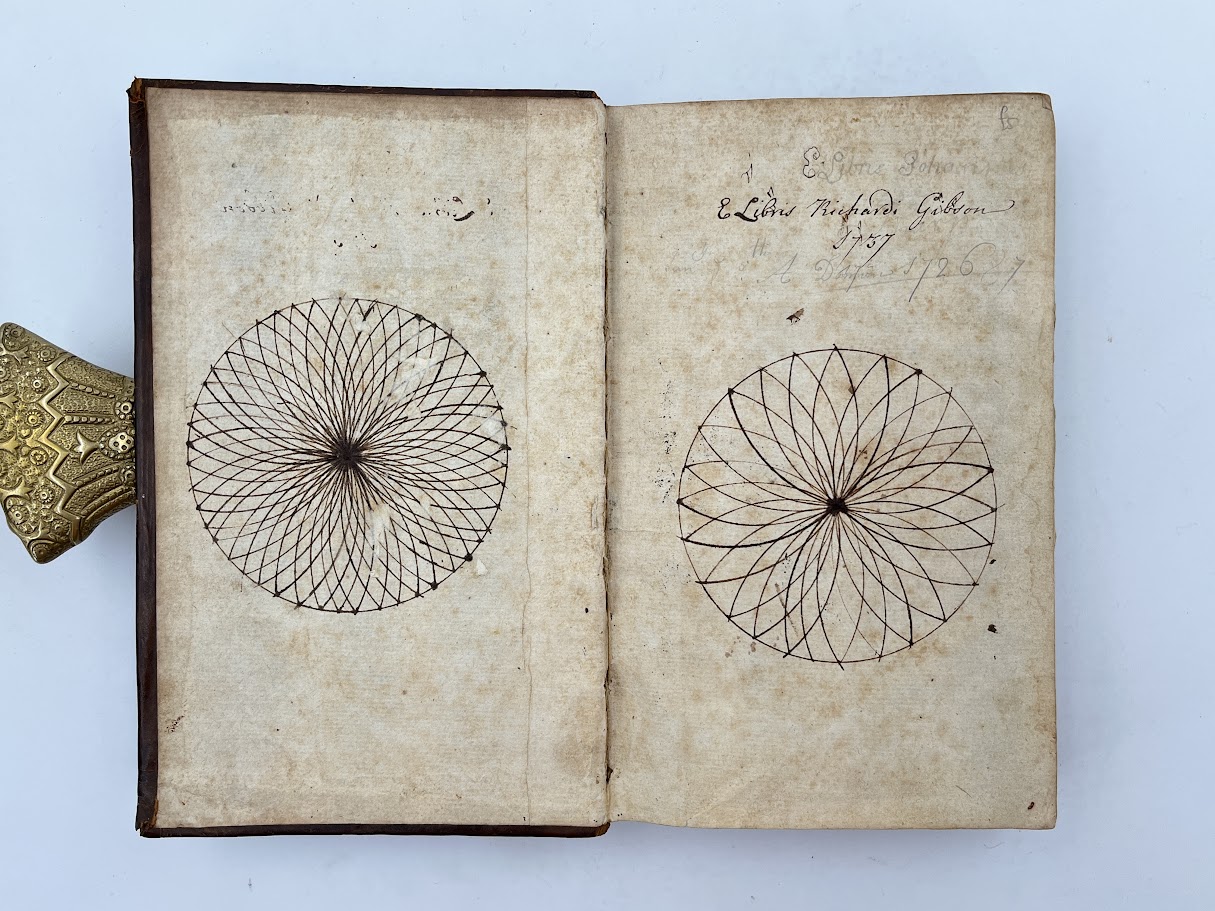
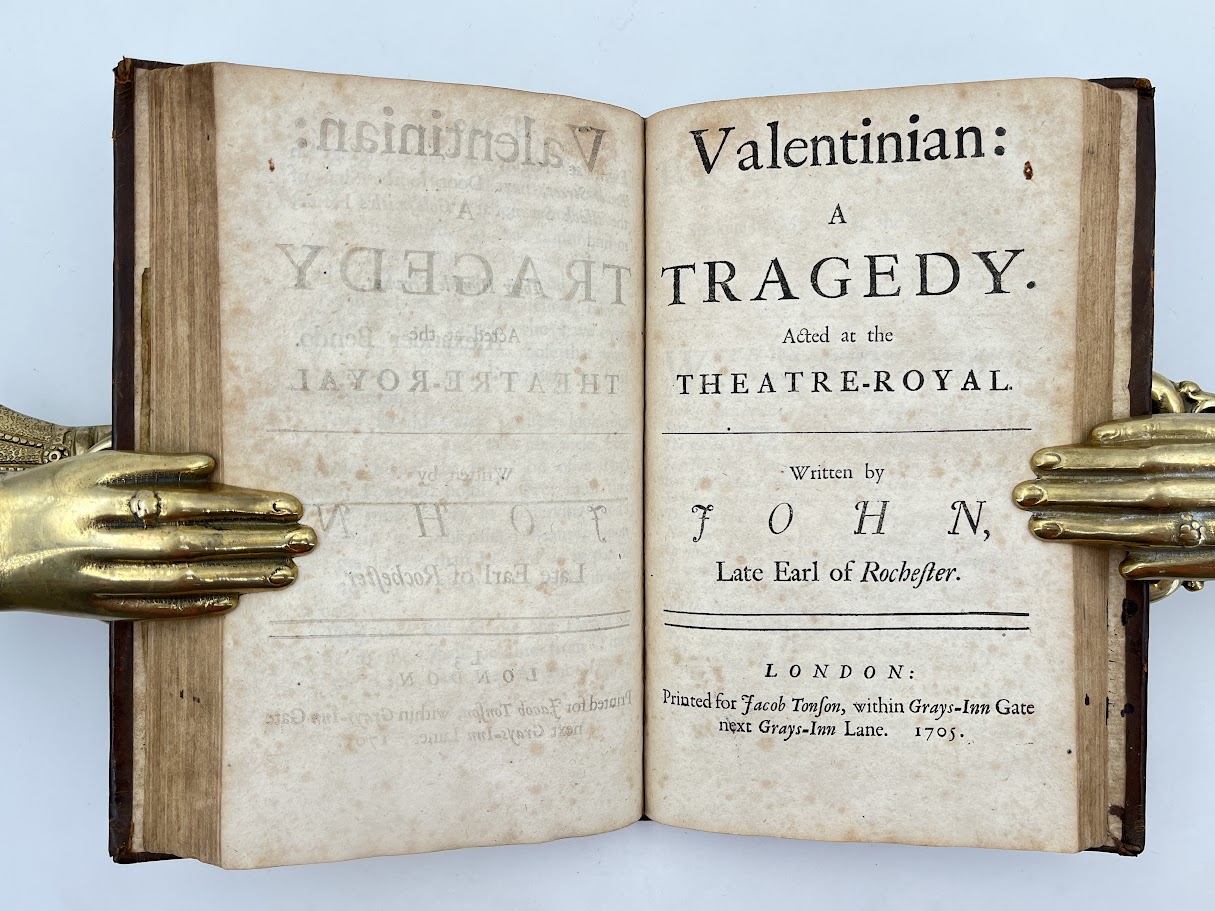
Early 18th century edition of Rochester’s poems in what appears to be a contemporary panelled calf trade binding, probably from the publisher Jacob Tonson. First published in this form in 1691 by Tonson, this was the second edition to be published in the 18th century and fourth overall. Rochester’s reputation as human being and poet has attracted scores of assessments and comments: Andrew Marvell called him "the best English satirist," and Voltaire referred to him as "the man of genius, the great poet".
DESCRIPTION: Contemporary panelled calf with spine label; fore-margin of title-page with folded slip of paper (perhaps a paper repair?) with handwritten text, ‘no man wise at all times nor woman wise at all times’ on it (Erasmus); ink circles on front end-papers enclosing petal shape ellipsis. Two slightly later ownership ownership inscriptions appear on the recto of the front free end-paper, one in pencil: "A. [?Domaris] 1726"; and, in ink, "E Libris Richardi Gibson/ 1737", spotting to text, severely in the case of the title-page and some other leaves, no final flyleaf, top and base of joints slightly cracked.
Collates pp. [x], xvi [xvii - xxi, xxii blank], 208,177 - 223 [224 Epilogue], pp. 177-208 repeated in pagination; but text and register are continuous.
CONTEXT: At the conclusion of his History of England, David Hume, assessing the writers of the Restoration, asserted, "The very name of Rochester is offensive to modest ears' yet does his poetry discover such energy of style and such poignancy of satire, as give ground to imagine what so fine a genius, had he fallen in a more happy age, and had followed better models, was capable of producing.”