A compelling association copy bringing together the Anglo-Irish novelist Maria Edgeworth who owned and annotated this copy and her Scottish-born friend, Martha Graham, who wrote this pioneering travel book about time spent in India. Edgeworth, who corresponded regularly with Graham, has inscribed the title page ‘Maria Edgeworth’ and added comments and marginal lines throughout the text, reading and annotating the entire book, appendices excepted only.
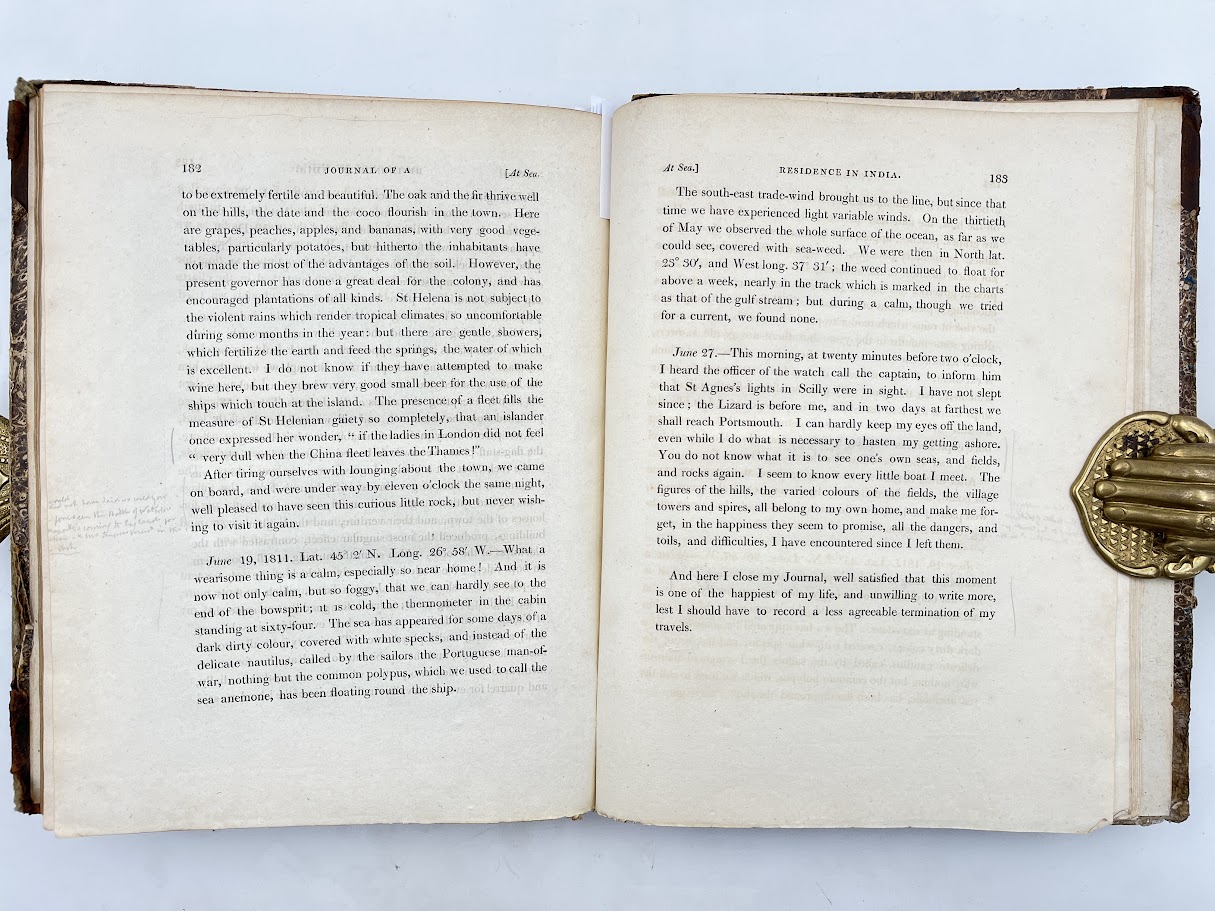
In one of a handful of verbal annotations Edgeworth responded strongly to a horrific account given by Graham of the Indian custom relating to ‘when a man becomes infirm’ and ‘his relations... take him to the banks of the river, set his feet in the water, and, stuffing his ears and mouth with mud, leave him to perish, which he seldom does without a hard struggle’. Edgeworth, with her Irish experience to the fore, and perhaps a hint of irony, has added the comment‘How different from the poor Irish!’ adding a marginal line for emphasis alongside the passage of text (pp148-9). Edgeworth makes another Irish reference when she adds the name of ‘Percy - Bishop of Dromerie’ below a little lacuna in Graham’s text who found herself unable to recall the author’s name. Particularly interesting is Edgeworth’s response to Graham’s description of St Helena which was written, crucially, in 1811 when she paid a visit during her return voyage to England but which Edgeworth must have annotated after Napoleon’s exile to St Helena in 1815-6.
In the margin Edgeworth notes: ‘would not have said so [Graham remarks on never ‘wishing to visit it again’]... foreseen the Battle of Waterloo... [Bona]parte’s coming to Eng court... and his imprisonment in the [island]’.
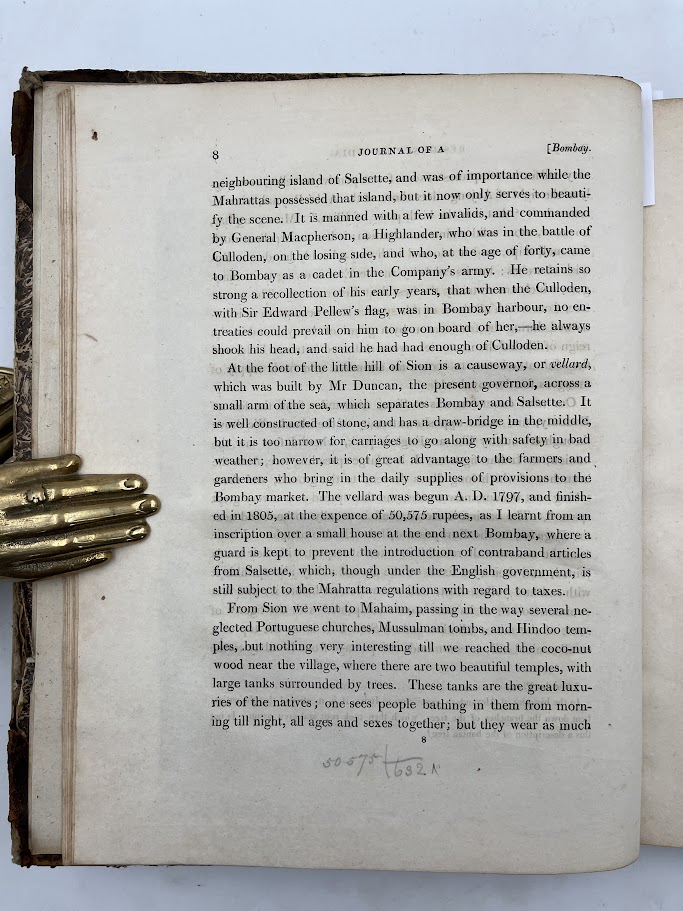
Early on in the printed text, Edgeworth makes a small mathematical calculation (p8) regarding the cost of land reclamation overseen in Mumbai by Governor Jonathan Duncan; she inserts a correction to a botanical description (p19), adds grammatically correct prepositions (p58 & 65). With marginal lines Edgeworth draws attention to Indian exports to the UK as well as underlining passages at pp27, 32-33, p155, p160, 163-5, p173 (re Admiral Drury’s kind attention to Graham as she left India), pp176-7 (’Moravian Hottentots’) and even leaves a coffee cupmark (p140).
MARIA EDGEWORTH (1768-1849) was one of the most widely read English language novelists around the turn of the 19th century, spending much of her life in Edgeworthstown in County Longford, Ireland, where she frequently acted as teacher and mentor to her many younger siblings (21 surviving in all) and shared her books with them. She is known as a keen annotator of her reading matter - we have handled her copy of Fanny Burney’s Evelina, elaborately annotated throughout.
MARIA GRAHAM (1785-1842) was a writer of travels and children’s books. A member of the Scottish Dundas family, she accompanied her father when he was appointed to run the naval works in Bombay, meeting and marrying her husband, a Scottish naval officer, on the voyage out. She continued to travel and write extensively after her marriage, notably on Chile (her observations about land rising from the sea would be confirmed by Charles Darwin) and Hawaii.
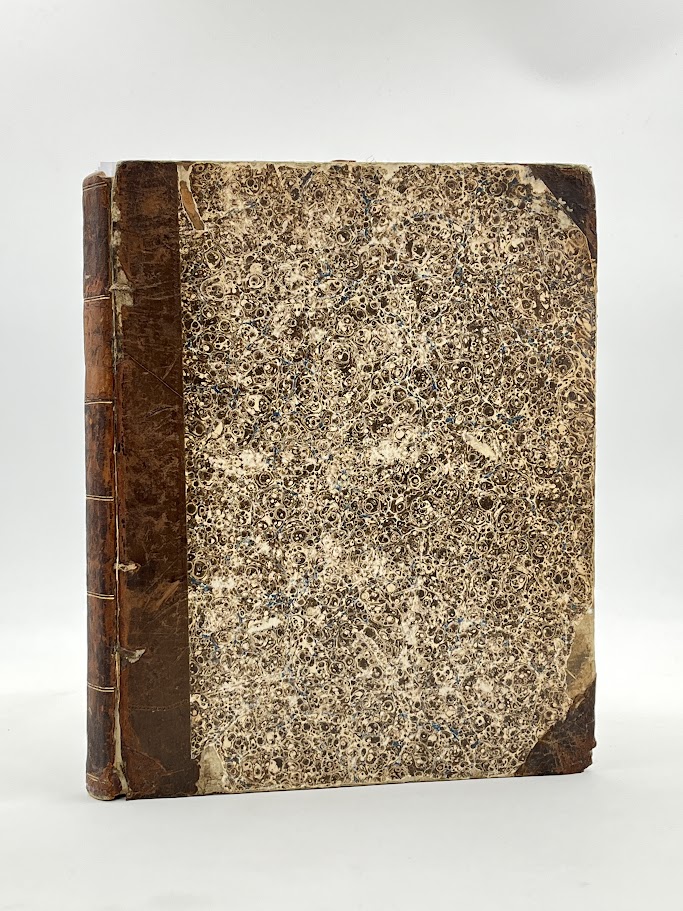
PHYSICAL DESCRIPTION: Quarto (22x27.5cm) bound in half calf over marbled boards; hinges very tender, holding by strings; scuffing and wear to edges and corners. Flyleaf partially detached; old creases to second fly; old paper repair to title page with upper corner nearest to gutter torn away and renewed with a pasted sheet behind. Edgeworth’s ownership inscription to the title page has offsetting to the flyleaf opposite which suggests that the frontispiece called for in this volume was never present - the other 15 plates and tissue guards are present. The final leaf of text is damaged along the gutter and there is no rear endpaper with just the traces of a stub in the gutter.