Unpublished late eighteenth century authorial working manuscript of an ambitious philosophical tract written by the controversialist, London poet, publisher and Quaker preacher Thomas Letchworth. Already a published writer on Liberty and Necessity in a slightly earlier controversial exchange with Augustus Toplady (1776), in this tract Letchworth deals with human volition and its connection with pain, a major philosophical topic of the age.
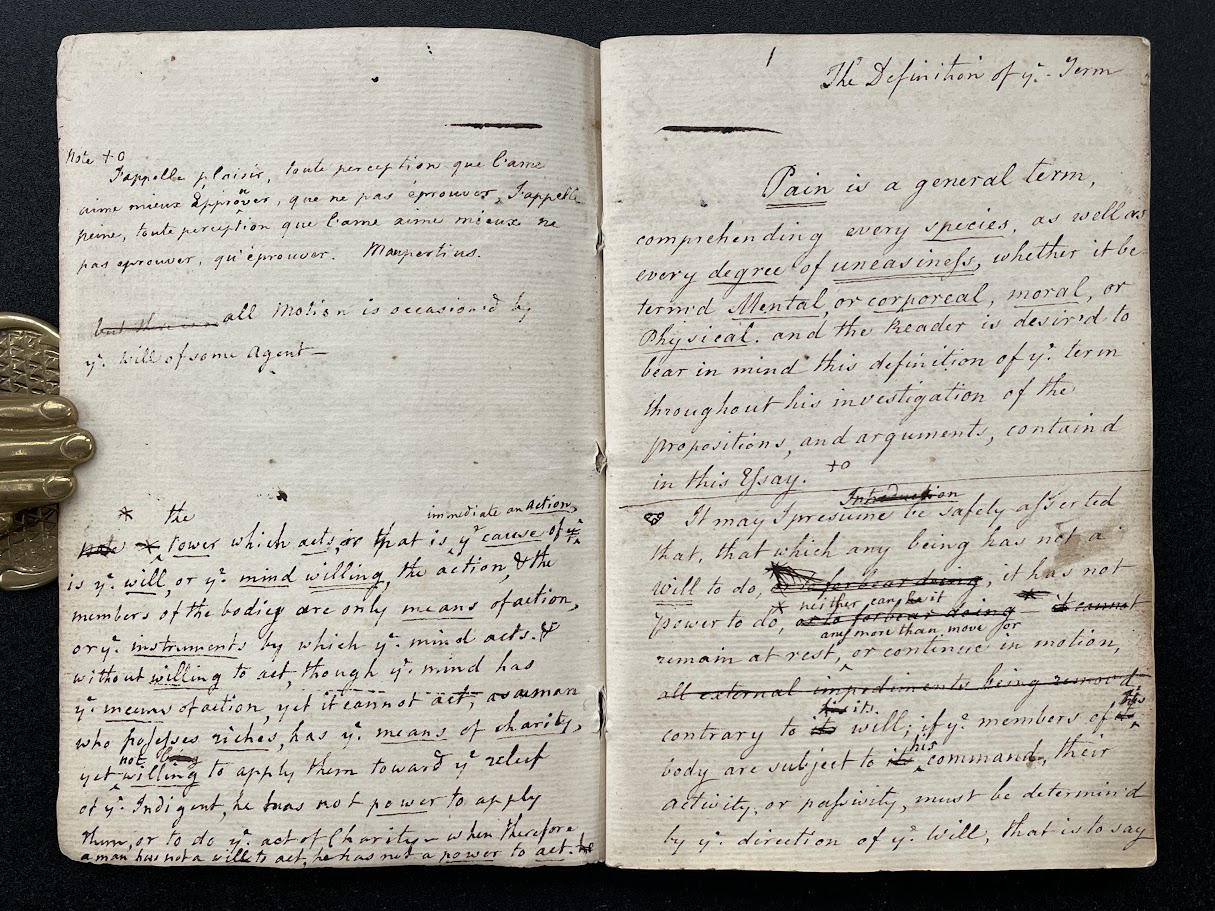
Working in a tradition that originates with Hobbes, at the outset Letchworth offers the proposition that ‘Pain is a general term, comprehending every species, as well as every degree of uneasiness, whether it be term’d Mental, or corporeal, moral or Physical, and the Reader is desir’d to bear in mind this definition of ye term throughout his investigation of the propositions and arguments, contain’d in this Essay.’ Letchworth promises not to make reference to ‘metaphysical subtleties above ye reach of vulgar apprehension... but what Mr Locke calls argumentum ad Judicium by appealing to Universal experience’ (Locke’s final arbiter in the Essay Concerning Human Understanding).
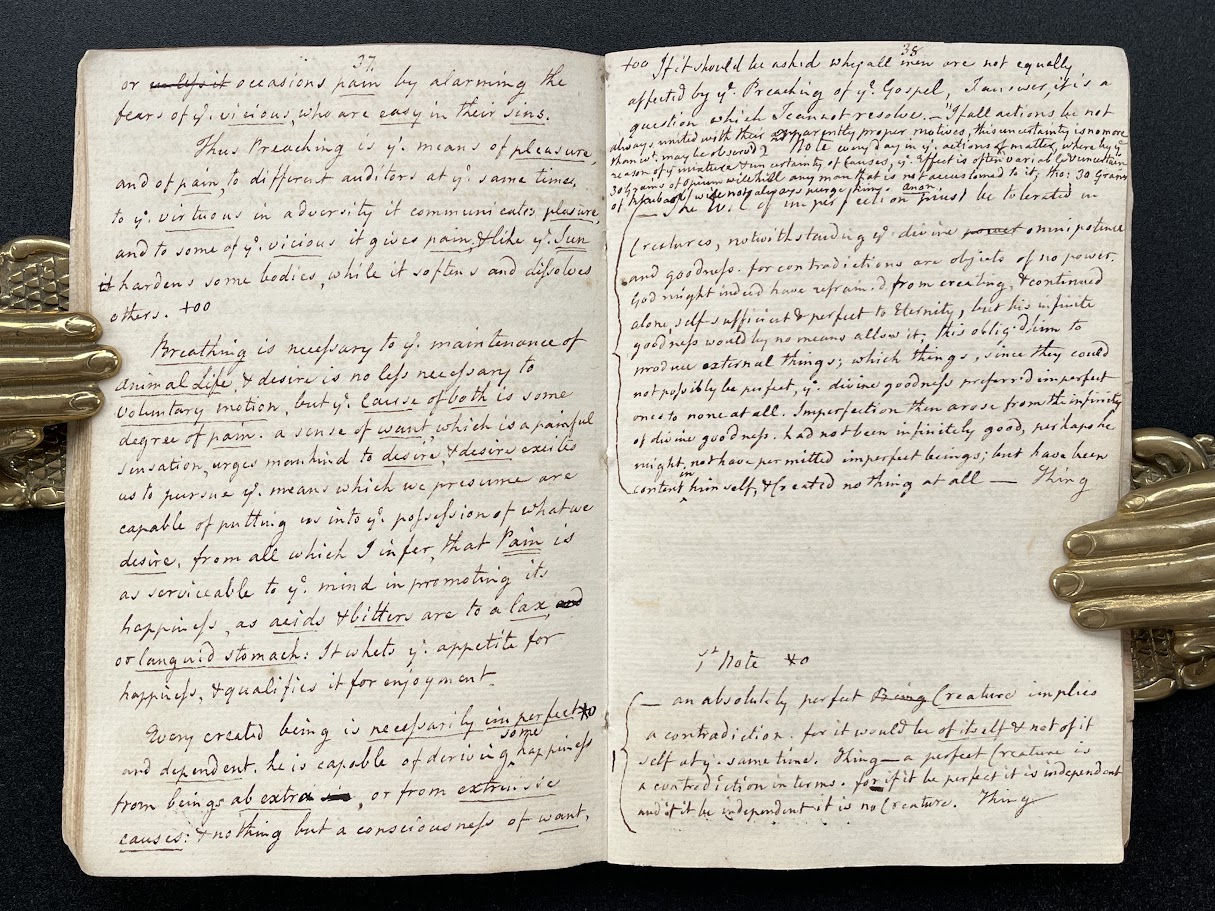
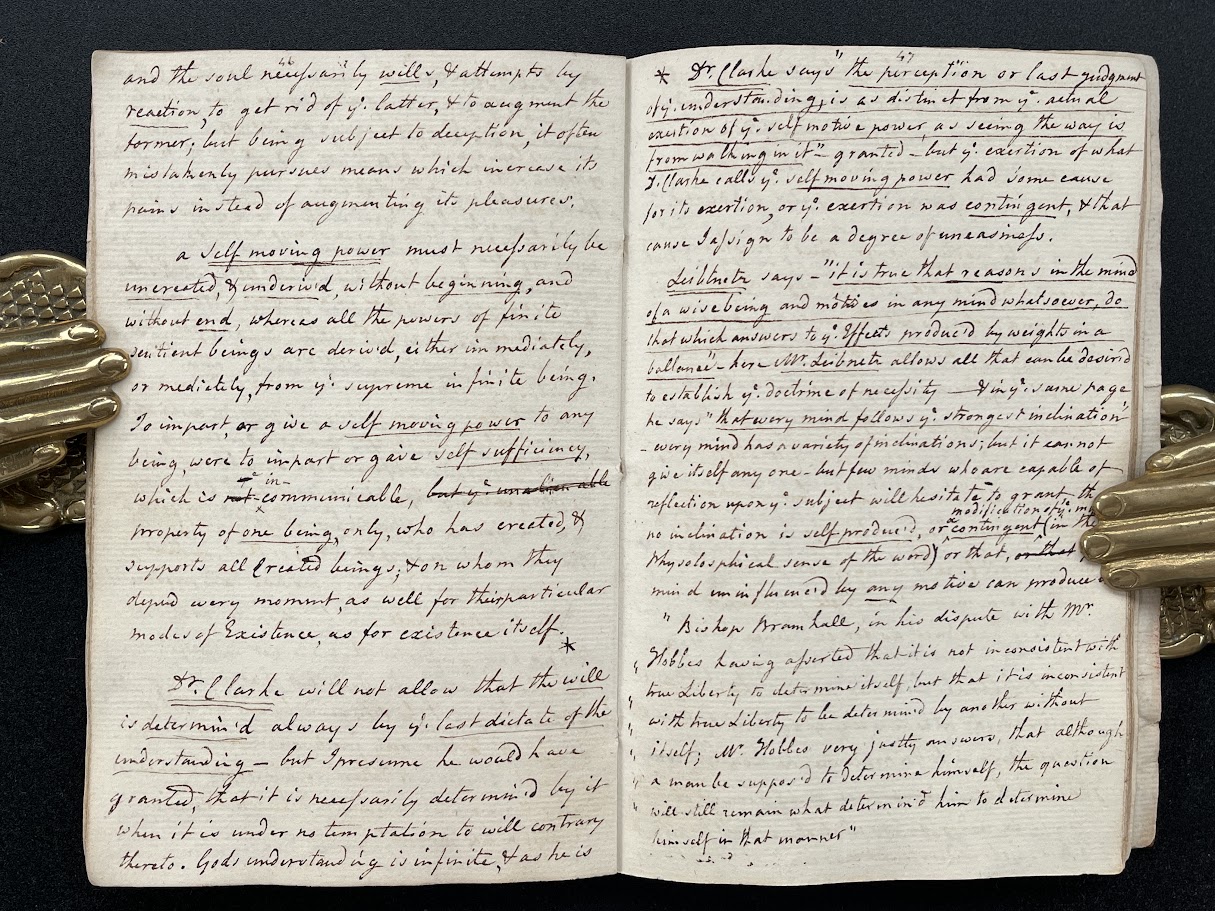
In the first full chapter Letchworth deals with matter and its relationship with perception; he considers the role of pain in volition in the infant, moving on to the relation of virtue and vice to pain and considers the role of preaching ‘to console ye Virtuous and to make ye Vicious miserable’. In Chapter 4 Letchworth considers ‘plausible objections’ to his thesis’, notably the role of free-will and divinity and then at some length in opposition to Samuel Clarke’s idea of ‘self moving power’ which was central to Clarke’s libertarian theory of free will.
Letchworth concludes with the ‘lessening of pain... pleasure.’ For authority Letchworth turns most frequently to Locke and Hobbes as well as Hume, Maupertius and Pope in his Essay on Man. Very much a working document, the manuscript is constructed around a central text with extensive apparatus and correction, sometimes on the recto and sometimes verso opposite. Although the role of the divinity in human agency is important to Letchworth’s argument, his authorities and argumentation is secular in nature.
Deriving from Hobbes and Locke’s idea of psychological and physical pain or ‘uneasiness’ as the mechanism of volition, the role of pain is seen as a foundational catalyst to human will. Letchworth writes at the junction between this enlightenment idea and Bentham’s codification of pain and pleasure into Utilitarianism. His text has not hitherto been available to scholarship.
We can find no record of the publication of this late work.
THOMAS LETCHWORTH (1739-1784) was raised in Norwich as a Quaker, moved to London where he published several volumes of verse and became the editor of The Monthly Ledger in 1773, publishing the Life of the American Quaker, John Woolman. His Morning and Evening’s Medition was printed and sold by Benjamin Franklin in 1766 and in the same year, under the pseudonym Philaretus’ he published An Essay on Liberty and Necessity which is tentatively ascribed to him by ESTC, an attribution which this manuscript appears to confirm.
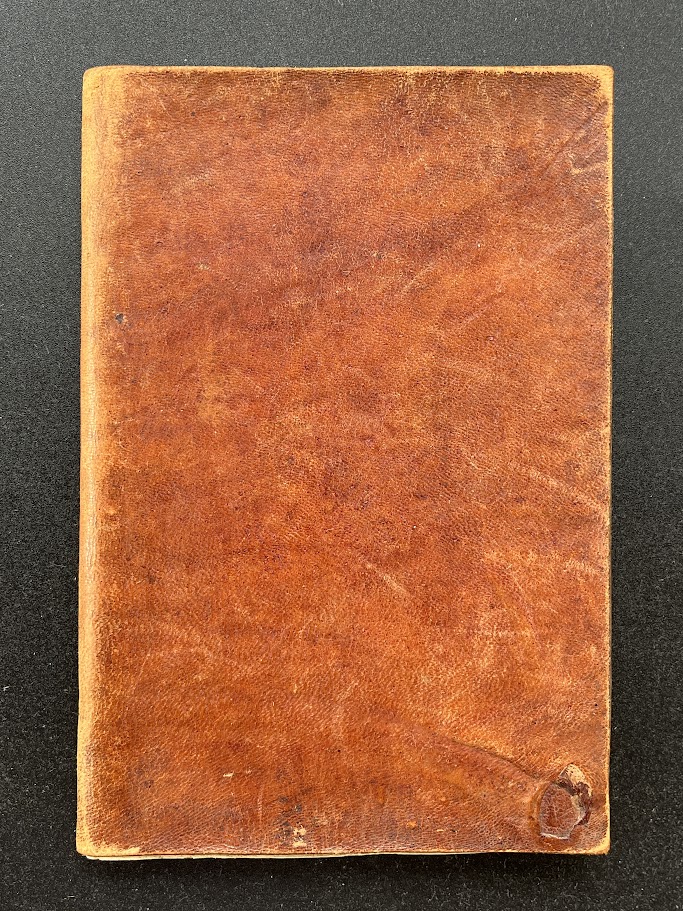
DESCRIPTION: Small octavo notebook (12.5x18.5cm) bound in roan over stiff card wrappers. Extensive provenance recorded on the front pastedown: ‘No 2 Great Litchfield Street, Oxford Market, Lawrence Thane’ (presumed relative of John Thane, manuscript and print dealer and antiquary who operated out of Litchfield Street, Soho). Below this Thane has attributed the manuscript to Letchworth: ‘A Manuscript of T Letchworth circa 1780’ and in another hand below this: ‘Another copy of the same Treatise in a smaller book’ - a few more notes in this hand appear at the end of the MS.
Letchworth provides a much-revised manuscript title page in which he repeatedly changes his designated title, inserting ‘human’ before ‘volition’ and giving himself the pseudonym ‘Philo-veritas’, adding an epigraph by Pope. The text runs to 60 pages (paginated) and four unpaginated pages, c6000 words. Heavily revised throughout with text and apparatus on opposite pages.