


AN ARTISTIC FRIENDSHIP: LETTERS BETWEEN THE CELEBRATED ENGRAVER AND ARTIST ROBIN TANNER & HIS OLD FRIEND, MAJOR RILEY.
RESERVED - A remarkable collection of letters from two natural writers with, most unusually, both sides of the correspondence reunited after their deaths by their families. These hand-written, frequently illustrated letters (in all c60,000 words) were penned during the 1980s and bring together the celebrated engraver and pioneering arts educationalist Robin Tanner and his long time friend and colleague Major Riley. As the pair, both writing during their own 80s, look back at their lives and careers, their letters offer a sort of autobiographical commentary which brings past and present together, and links a period in which Tanner experienced his artistic renaissance with Major’s reminiscences of an Edwardian childhood working as a ‘bobbin ligger’ in the Yorkshire mills.
In the most beautiful visual form, the pair engage with the idea of their legacies and reflect upon lives spent in a rapidly changing world while watching the education system they helped build dismantled by the Thatcher administration and, as they see it, the destruction of the English countryside and way of life they had loved.
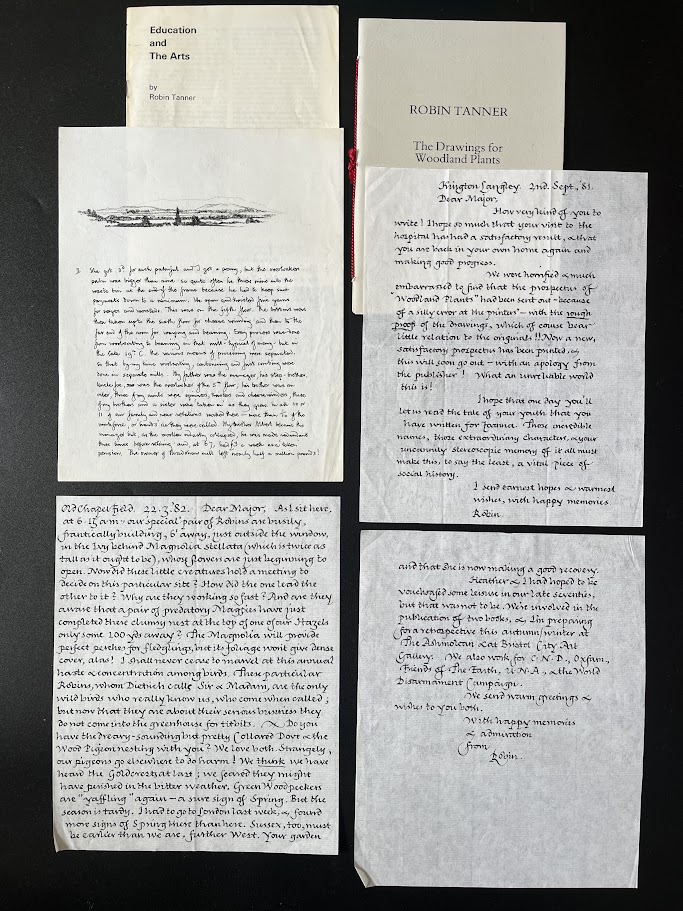
ROBIN TANNER’S LETTERS TO MAJOR RILEY AND MILLICENT RILEY : c45 manuscript letters written between 1978 - 1985; c30,000 words; on paper headed Old Chapel Field, Kington, Langley, Nr. Chippenham. Wiltshire.
Robin Tanner, 1904-88 was a talented etcher, a graduate of Goldssmith’s College, heavily influenced by William Morris and Samuel Palmer and deeply embedded in the British Arts and Crafts tradition. His early career as a pioneering art educationalist and his role as an HM Inspector of Schools influenced the development of art in education in England. In the letters he writes of how ‘we fell into talking about the good old days (when of course we knew we were living in a golden age for education, and never dreamt of the awful situation today’. Working alongside his wife Heather the pair published Wiltshire Village (Collins, 1939), Woodland Plants (Robin Garton, 1981) and Country Alphabet. Both were committed Quakers, pacifists and staunch supporters of CND. Tanner co-founded the Crafts Study Centre in Bath and was celebrated in the early 1980s with major retrospective exhibitions of his work at the City of Bristol Museum and the Ashmolean Museum in Oxford, ‘such talent as I may have is of an essentially minor, limited, provincial kind. I didn’t want the Bristol and Oxford exhibitions... I felt my work would be far too traditional..... surprisingly I’ve been proved entirely wrong’.
The intense letter-writing phase to Riley which spans the years 1981 until his friend’s death in 1983 captures an elderly artist processing this late-stage professional vindication and also evokes his love of the English countryside, its customs and traditions, ’as farming becomes more mechanical and farm workers leave the village their cottages are ‘improved’ by well off people, most of whom have no idea of country life’.
Each letter faithfully includes a description of his beloved garden revealing a deep botanical knowledge and strong preoccupation with ecology and conservation, ‘bullfinches are already raiding the apple trees, I think the Celandines, Coltefoot flowers and scented white violets- wildflowers I impatiently wait for - give me as great joy as any garden flowers’. Our writer shares news of the publication of Wiltshire Woodlands Plants and in later letters news of its American publication. Thoughts on designs for new plates, printing techniques and preparations for new etchings called Fritillary Field and July are detailed alongside his love of baryta paper and silver point.
A distaste for ‘modern art’ pervades his descriptions of ‘trivial rubbish at the RCA student show’ and a dislike of Mark Rothko and the Americans. Memories of early days in Leeds are evoked, ‘your mention of the remarkable Jacob Kramer and Philip Naviasky took us straight back to Leeds in 1934’..... ‘I only knew the English romantic Sutherland and Sickert I often used to see in Bath’.
A young etcher visits and Tanner happily reports, ‘Not all the young have gone modern. He has hard things to say about his art school training, where good drawing was quite frowned upon. How silly we have become!’ The Nationwide team descended to make a BBC documentary in November ‘82 and by March ‘83 letters turn to the Craft Study Centre which is under threat. Tanner despairs, ‘we are fast becoming an illiterate boorish nation’ and donates all of his profits to keep the Study Centre going. Political views are shared, ‘I haven’t an atom of respect for Thatcher and Reagan or Galtieri or Begin or Mis Ghandi... Major Riley would make a better P.M.’ Riley’s letters are eagerly awaited ‘we three await each chunk of autobiography you send with great eagerness... I read it aloud sometimes more than once’.
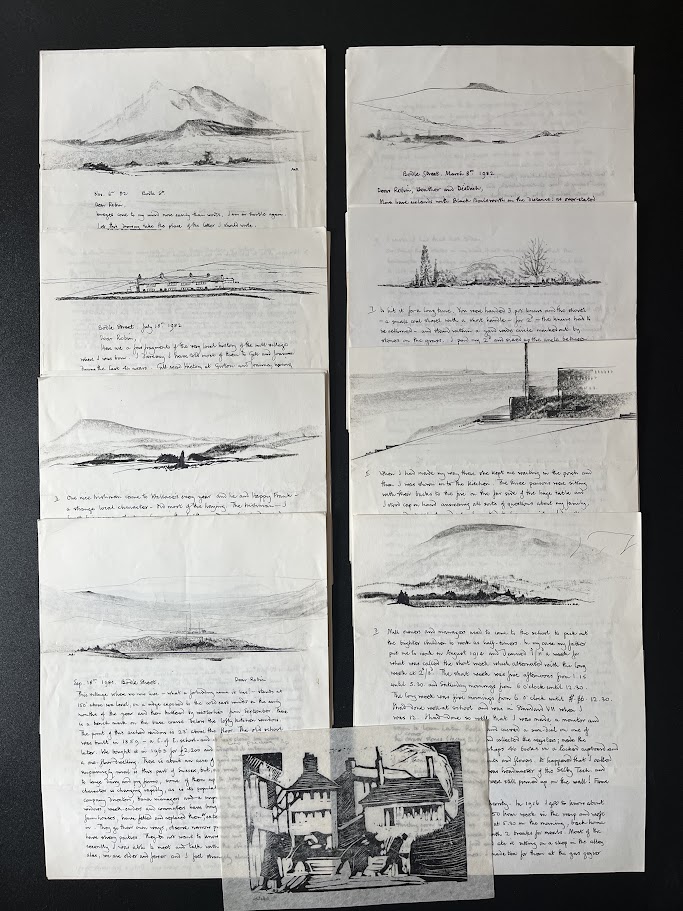
MAJOR RILEY’S LETTERS TO ROBIN, HEATHER AND DIETRICH TANNER: c18 manuscript letters written between 1981 and 1983; c30,000 words; 24 hand drawn illustrations of landscapes in pencil and charcoal to letter heads; on paper headed Bodle Street, [Hailsham].
Major Riley was born in the village of Bradshaw in West Yorkshire in 1902 leaving school at 13 to become a ‘bobbin ligger’ and ‘doffer’ in the local mill. He attended Ackroyds Place night school 3 nights a week to learn object drawing and geometry, winning a scholarship to Halifax School of Art. He lectured at Bradford College of Art for 7 years from 1925 and went on to establish and lead the Selby College of Art and Crafts, transitioning later in his career to become a district inspector of art and technical schools.
Beautiful illustrated letter tops throughout the entire set of letters reveal Riley’s artistic talent described by Tanner as ‘evocative and essentially true’ and prompting him to ask, ‘why is your work not better known?’. Major laments that he ‘hasn’t sold any of my work since 1926’. Tipped into the collection is a print, ‘I made a drawing of a high wind at Queensbury and then cut it on a block with gouge, chisel and knife. I enclose a print made last week when I came across the block in a dusty box in the attic. Now why have I saved it for 55 years and more?’. Riley remembers, ‘When I began teaching.... most of the students came from Grammar and High Schools - young ladies mainly.... only a few of them had any ability to draw and I was able to show them into needlework... and then the others gradually got hold of the notion that to learn how to draw meant observing things, people, events, structures etc outside the College studios’.
Like Tanner modern art leaves him cold, ‘my blood boils when that money grabber Picasso and his present day sycophant Hockney are lauded in the media’. An illustrated letter head on a letter dated September 1982 causes him to write, ‘uncertainty of touch and flagging imagination have at last forced me to adopt impressionism. It didn’t matter in 1920, nor does it now’. The pair share a mutual respect for Cotman but ‘Duncan Grant a painter NO NO NO.’. A detailed description of a trip to Paris in 1929 to visit his schoolboy friend J.M. Hansom includes a trip to Picasso’s studio in order to help buy a painting for the Swedish Embassy. (Joe Hansom was an old friend from Illingworth who like Major attended night classes while working on his father’s farm and went on to become a Professor at Cornell University).
Encouraged by Tanner, autobiographical detail fills the leaves full of vidid memories which describe a world he once knew; the family cottage at Needle Row consisting of one living room and one bedroom, sleeping four to a bed. ‘By the age of 7 after countless thrashings with a thonged leather strap made from 2 2 mill belting, I became the demure and bidable creature you came to know 40 years later’.
Memories of his Edwardian childhood, local characters,‘Happy Frank, Onion Jack, Jimmy Poke, Pea Robin and Daft Jane’ and hard years in the mills are relayed in vivid detail alongside inspectorial memories including a secondment to Belfast to invigorate its technical colleges and school of art, ‘When I got back I wrote a very carefully worded report and made recommendations and never heard one word from our own Ministry or from N.I. Similar contretemps bedevilled me at Oldham, the RCA (Darwin was very offensive) and at Bradford..... and of course Macclesfield. And then in 1952 I was investigated by MI5. Perhaps I have told you that story ? about officialdom at its silliest’. Reflections on time in Selby prompt, ‘realising that a full time School of Art was downright nonsense in a small market town, I set about providing industrial and commercial courses’. Politics are shared, ‘the whole world is mad. The lust for blood, money, power and domination robs all... of love and peace’. News of Major’s death in 1983 prompts Tanner to write to Millicent, ‘I cannot get used to the idea that that tall, sensitive, quietly authoritative, versatile, independant thinker and artist and lover of life is no longer here’.
PHYSICAL CONDITION: In very good condition throughout. Entirely legible. Collection includes letters written between Millicent Riley and the Tanners following Major Riley’s death in 1983.