
‘AS FAR AS EUROPEANS ARE CONCERNED... A NEW PLACE’ A 625 mile Journey around Ugandan Lakes Kioga and Kivania and Surrounding Waters by the Director of Uganda Railways
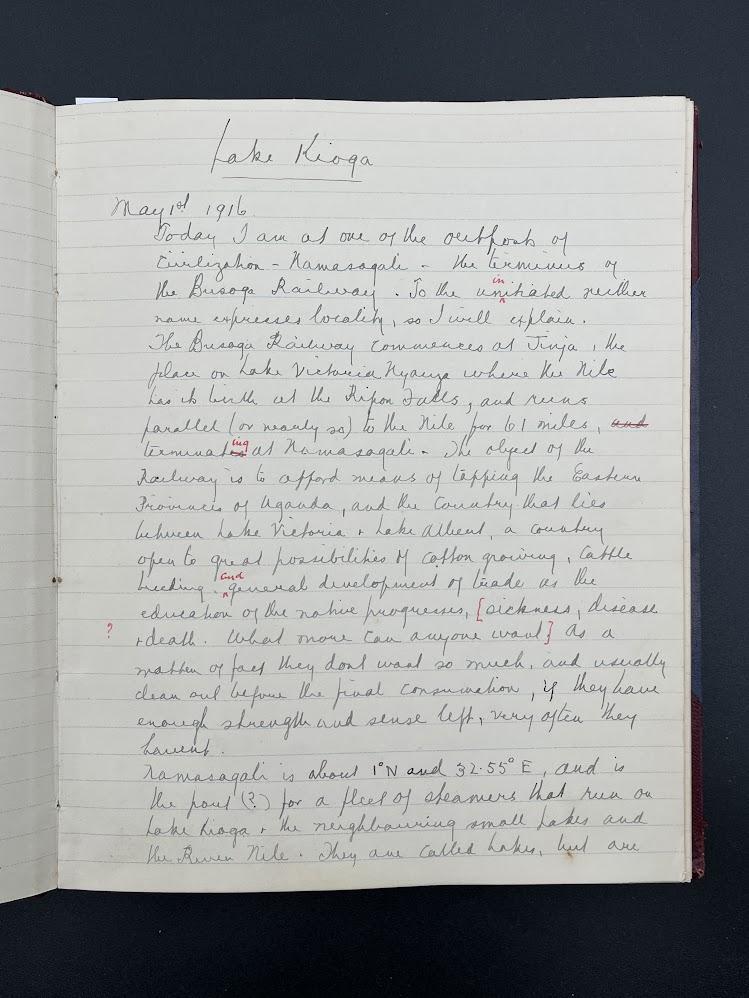
The opening sentence dated May 1st 1916 on paper headed ‘Lake Kioga’ locates our writer in his own words ‘at one of the outposts of civilisation - Namasagali - the terminus of the Busoga Railway... it is certainly having things up to date to have trains alongside a steamer... in a place only 3 years old in the heart of Darkest Africa’.
An avid hunter (he was tossed by a rhino in 1901 and had his arm amputated) Eastwood enjoys the engineer’s testimony on his boat, The Speke, especially tales of poaching for elephant tusks and his time in charge of the steamer transporting Winston Churchill along the Nile during a hunting trip to East Africa and Uganda, ‘what could any man want more than the chance of two elephants every time he went up and down the Congo’.
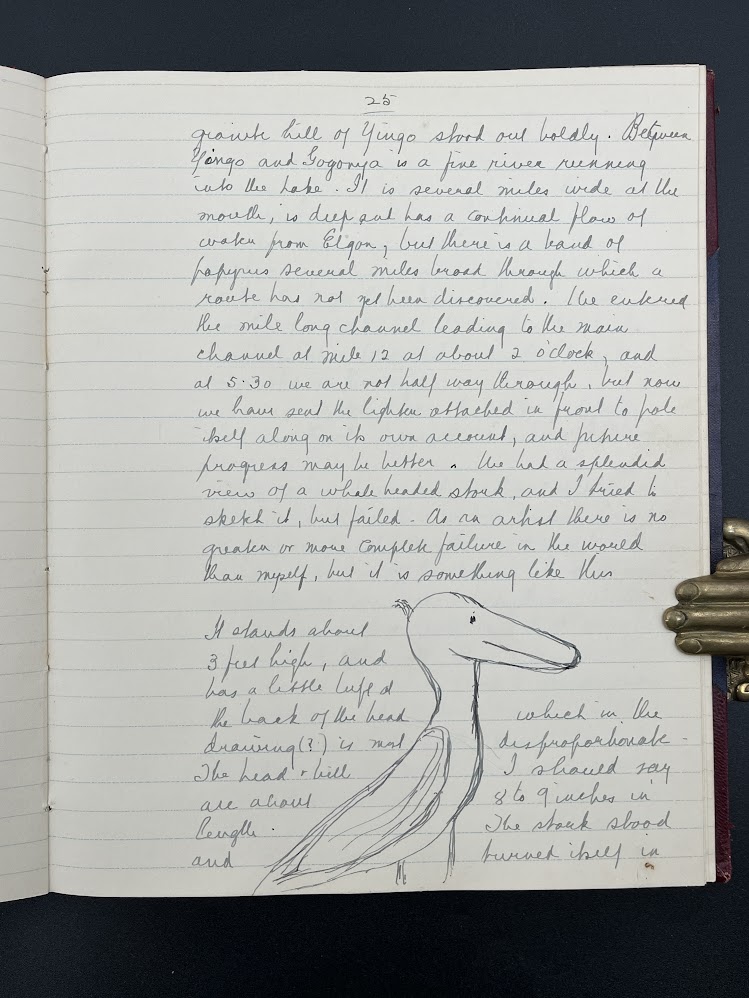
Passage through the canal head offers sightings of lily hoppers, kingfishers, eagles, rare whale headed storks (’must not be shot’) and pigmy geese (’very good eating’).
It is recorded that a tribe named the Wakenya live among the papyrus and another tribe 15 miles further along the canal who live ‘about Naranga’ on the Northern shore, ‘have a reputation that is not conducive to strangers sitting in their midst’. A tale of two missing Indians who employed one of the tribe’s canoes concludes with, ‘neighbouring tribes say they have been eaten’.
Floating papyrus islands blocked Westwood’s route and progress was slow. Each port or pier along the route is surveyed and described including Sambene ‘with its office of wattle and daub and a grass thatched roof. There are openings in the walls, but neither doors or windows, and the paper and documents in it, also a safe.... at the mercy of any passer bye’; a blacksmith shop, ‘extreme primitiveness but yet strangely effective’.
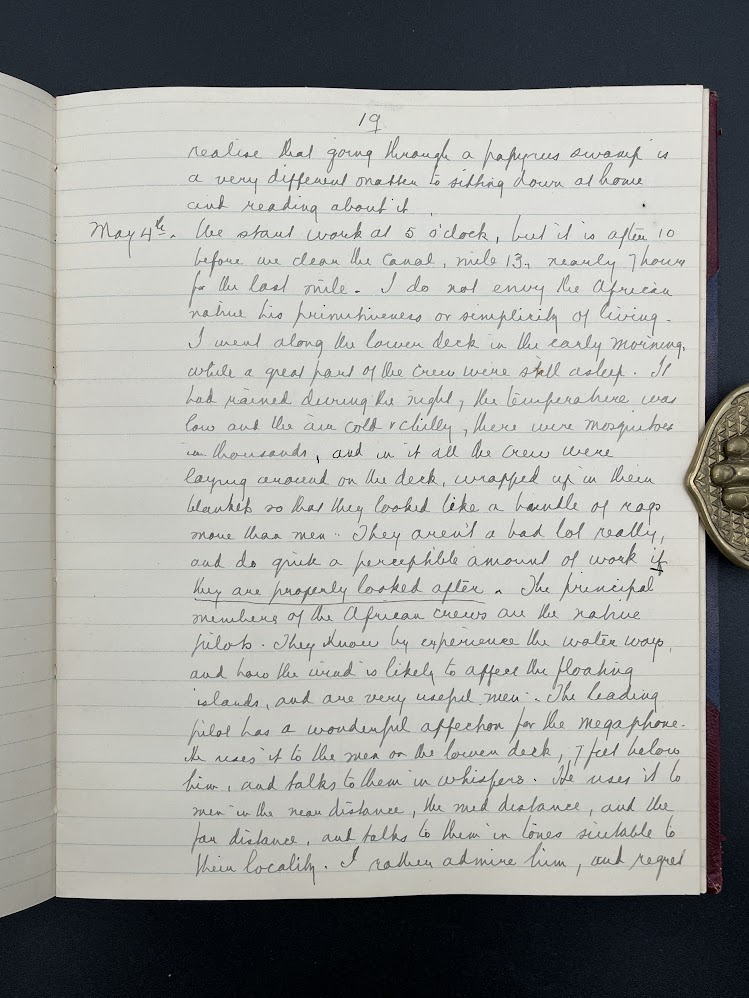
By mile 13 our writer admits, ‘I do not envy the African native his primitiveness or simplicity of living’... ‘they aren’t a bad lot really and do quite a perceptible amount of work if they are properly looked after’. Properly looked after is underlined.
The junction with the canal to Agu comes into view by mile 16 and the journey proceeds on to Gogoanya, ‘as far as Europeans are concerned is a new place’... ‘the steamers went there first in June last year, in August 40 tonnes of cotton seed was distributed among the chiefs’..... ‘stone buildings erected the middle of February’.... ‘the Indian traders and the one white man in the place are there to welcome us’. It is noted that no route has yet been discovered along the fine river running between Yingo and Gogoanya.
A length of canal packed with small craft of different sizes coming from Agu and ‘anywhere cotton is dealt with’ appears, ‘there were altogether 16, [.... ] and dugouts holding from 1 ton to 10 tons’. The settlement of Bugondo is described as ‘a place of more importance’ having a post office, a telegraph line and 2 ginneries owned by the British East Africa Corporation. Our writer describes the production of cotton bales, ‘the power is suction gas generated from cotton seed....... there are two sets of 4 saw gins...... nearly 100000 of raw cotton in 9.5 hrs’. The hydraulic baling press is admired, ‘there are 6 different handles that require constant and changing manipulation, and the authorities at home considered that either an experienced European or Indian would be necessary to work it but it is now entirely controlled by a Bukedi native on R14 a month’.
Plans to expand the pier and hopes for an increase in trade are noted for the port of Killi and the port of Masindi reveals what is described as the first ‘real pier’. Eastwood learns by Reuters telegrams a week old of the surrender of Kufaftea, ‘a siege of 143 days’. The small port of Atura ‘shows signs of advancement and progress’ and our writer admits, ‘I suppose every port and every outstation in this part of the world has its distinct toll in human life’. A note is made of ‘300 houses and huts in the district’.... ‘the natives are agriculturalists’.... ‘the Indian shops are clean and well kept‘..... ‘we went in several and the variety of goods kept is wonderful. Coloured cloths and blankets, [... ], scents, jams, pickles, scented soaps, general groceries, beads, wine’... ‘the steamer comes once a fortnight’.
An ‘almost royal progress through the village’ proceeds and the villagers express the need for a goods shed on the pier and a weekly steamer instead of fortnightly, ‘I tell them that the cry of their words has reached me in Nairobi and I have come to see for myself.’
A number of ‘natives’, some hauling a ‘Kamali caul’ pass by, ‘a Kamali caul takes a load of 2000lbs and has a crew of ten men, who are paid R4 or 5 a month all in’. Lunch with the Provincial Governor of Masindi (beautifully kept lawns, tennis courts, elephant skull decorations) and a deputation of Indians sees calls for more reform, ‘they want a reduction of charges (which they will not get)’. Mr Boal’s and M. Mongach’s coffee plantations are admired and another lunch with the President of the Planters Association is enjoyed, ‘he too wanted reductions’.
Reaching the harbour at Buhaba our writer notes, ‘There are only 2 Europeans at present..... Mr Reynolds and his wife... she is alone for some 5 days weekly..... she doesn’t mind elephants wandering occasionally in her front garden... but she doesn’t like crocodiles’.
The clean waters of Lake Kwania take them to Aputi ‘of little interest’ and Nabieso, ‘the place generally looks as if it were once under intelligent cultivation’. Earthwork piers are inspected and there is talk of a new road connecting Kachuag with the market town of Lira 28 miles away, ‘4 miles of roadway has been completed with a full gang of 500 men’.
The final page dated May 14th 1916 written back in Namasagali states, ‘one of the features that stands out most prominently on this journey is the important part that the Indian traders are taking in establishing and developing resources of the country’..... ‘the fact to my mind most unmistakably remains that if it were not for the Indian trader and merchant there would not be the trade offered that has brought into being the Lake Kioga flotilla’.
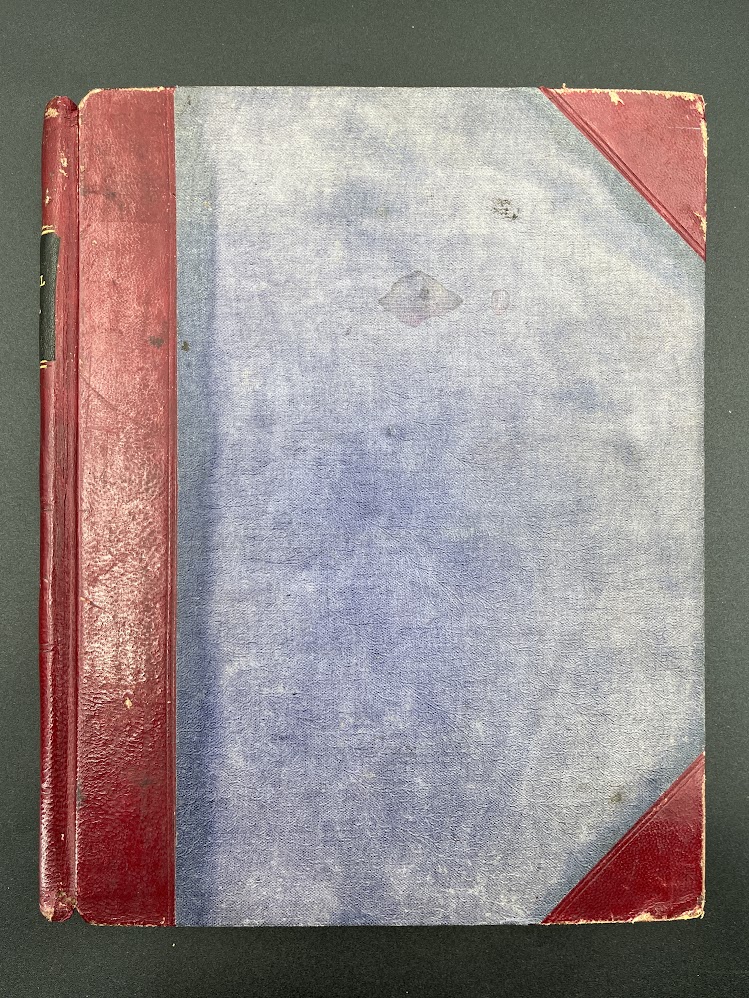
PHYSICAL DESCRIPTION: Quarto in very good condition. Hardbacked half red roan over blue cloth boards titled in gilt over black ground to spine ‘M.S. Journal Uganda 1916’. Marbled endpapers and text block clean throughout. Pasted in opposite the tiel page is a large blueprint folding map titled, ‘Sketch Map of Eastern Province’ dated October 16, 1915. Map measures 65cm x 65cm in very good condition. Inscription to front free endpaper reads ‘To J L Q Gower with kind regards B. Eastwood 6/1/18’. Title page reads ‘Sudd and Lilies’. c 17,000 words in a neat and legible hand, possibly a fair copy but with corrections in red ink.