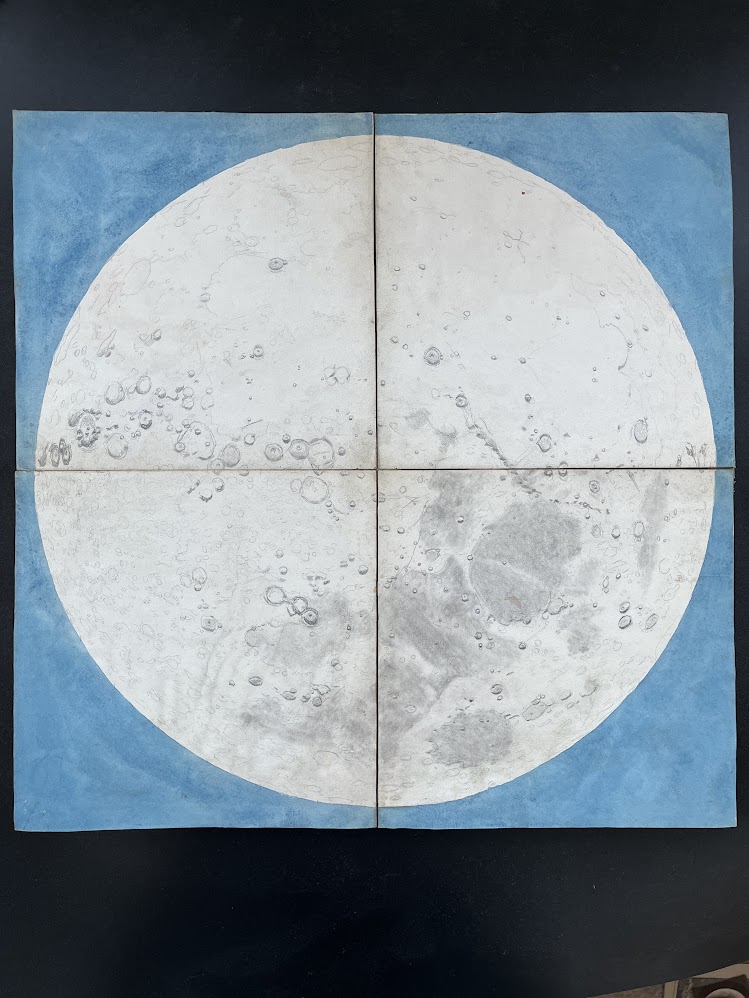
Fascinating archive containing lunar photography, celestial mapping, and sundial calculations by a career scientist whose optical equipment saw him move from an early Fellowship at Trinity College, Cambridge into industry. Spanning his career from the early 1900s to the 1950s, the collection includes correspondence, observational data, a large format drawing of the moon together with astronomical photographs of the lunar surface and a short manuscript account of Galileo’s discovery of the moons of Jupiter a well as an offprint of his major publication, The Growth of Metallic Eutectics, co-authored with J. T. Scott.
Included are:
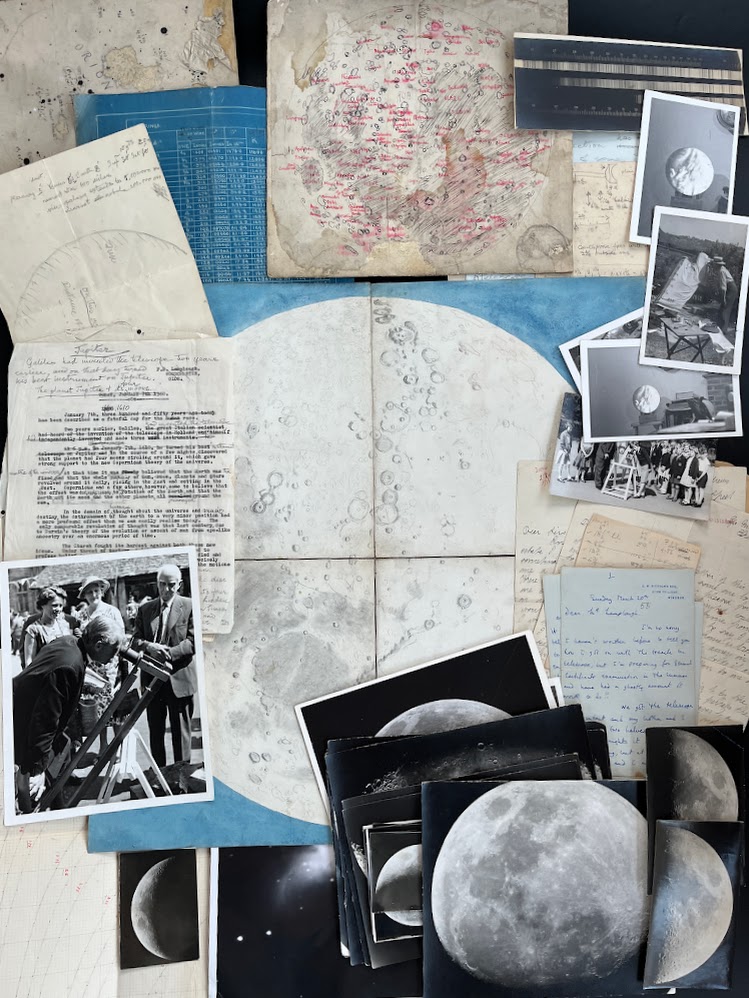
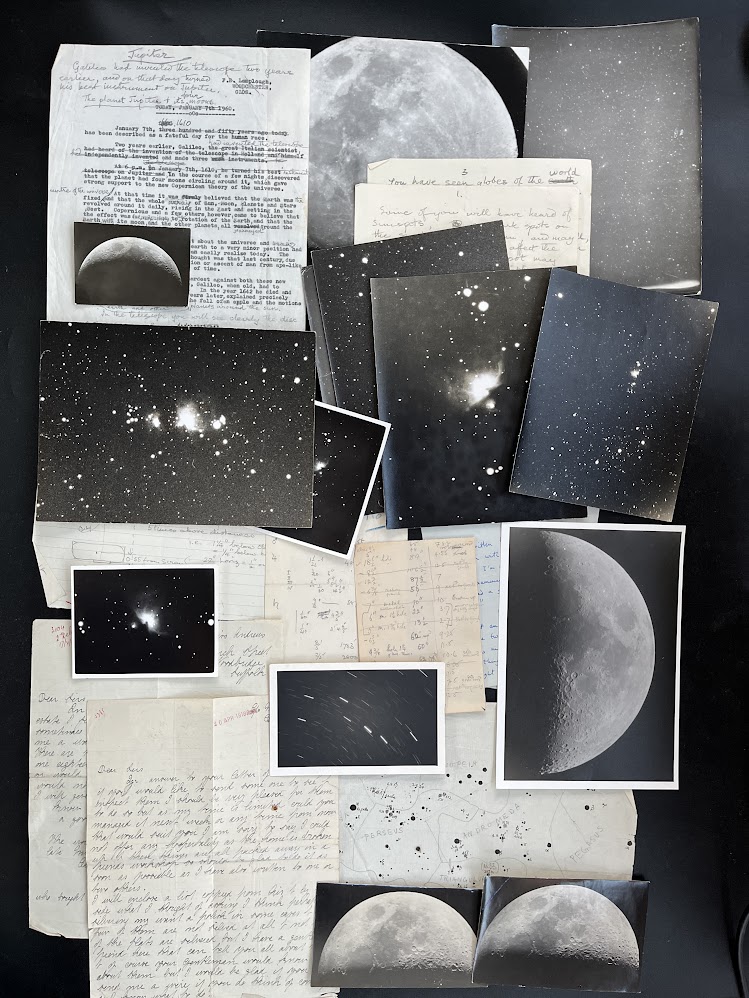
1 “Moon Map 1910 photos”; A4 manila envelope containing twenty-two silver gelatin prints of the moon—taken via telescope
2 “Star Photos especially Orion” - ten silver gelatin prints, annotated with details of lenses and magnifications
3 “Misc Moon” small mounted moon photograph
4 Moon, large watercolour and pencil drawing; 4 sheets of art paper taped together to verso; 46x46cm l
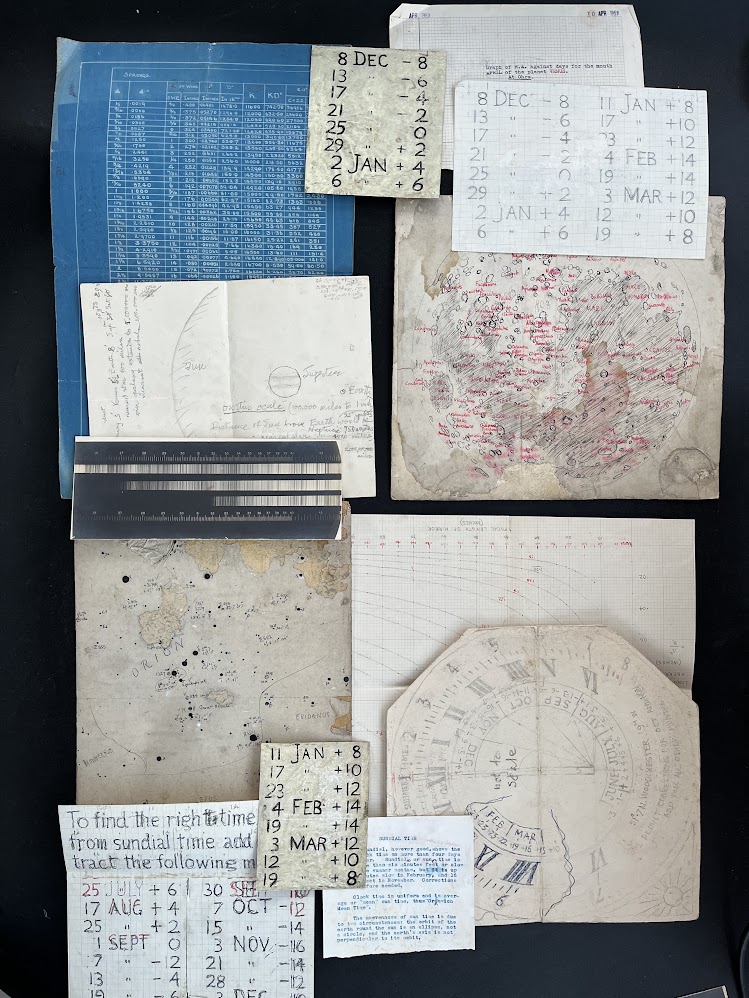
5 Hand drawn map on cardboard depicting: i Orion, Lepus, Monoceros, Eridanus, Auriga, Perseus, Lynx and Camelopardalis and ii moon map, heavily hand-drawn and annotated;
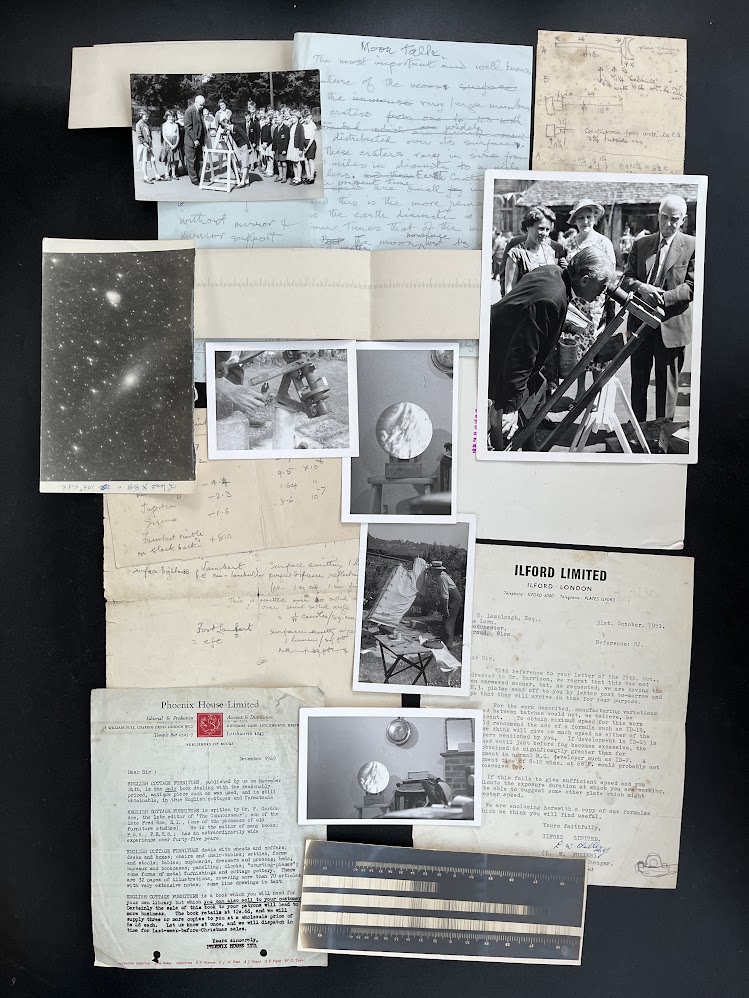
6 Silver gelatin prints depicting the use of a telescope with children from Lamplugh in old age; and a postcard re Patrick Moore.
7 Fold-out pencil drawing of a sundial from his home at Woodchester, annotated “not to scale” together with an envelope of sundial calculations
8 The Growth of Metallic Eutectics by Lamplough and J. T. Scott (1914) Proceedings of the Royal Society
9 ‘Today, January 7th 1960’, 350th anniversary typescript article with corrections on Galileo’s discovery of the moons of Jupiter
10 Letters and Ephemera: TLS from Ilford Ltd re photographic plates; notes for a ‘Moon talk’; notes on stellar magnitude; ALS [pp]8 from Richard Rickards to Lamplough concerning telescopic observations; and numerous pencil sketches of telescopes dispersed throughout the material.
Francis Edward Everard Lamplough (1881–1975), British scientist was a sometime Fellow of Trinity College, Cambridge, whose work moved between astronomy, chemistry, and optical engineering. Educated at Oundle and at Cambridge, where he took a First in the Natural Sciences Tripos in 1904, he was elected a Fellow of Trinity in 1906 and later served as an Additional Demonstrator in Chemistry (1914–1917).
Early in his career he worked on the annealing of optical glass at Chance Brothers, developing an enduring interest in the properties of glass and light, possibly as an independent inventor or consultant.
In later life he lived in Woodchester, near Stroud in Gloucestershire where most of the correspondence is addressed.
During the Second World War period he was connected with the Royal Aircraft Factory at Farnborough, reflecting his involvement in applied scientific work in service contexts.
Lamplough is best known for developing ‘Vitaglass’ in 1926, a high-quartz-content glass intended for improved optical performance. Alongside this industrial and scientific work, he pursued sustained astronomical observation, producing detailed lunar photography, celestial mapping, and sundial calculations that reflect a lifelong preoccupation with measurement, light, and precision instruments.