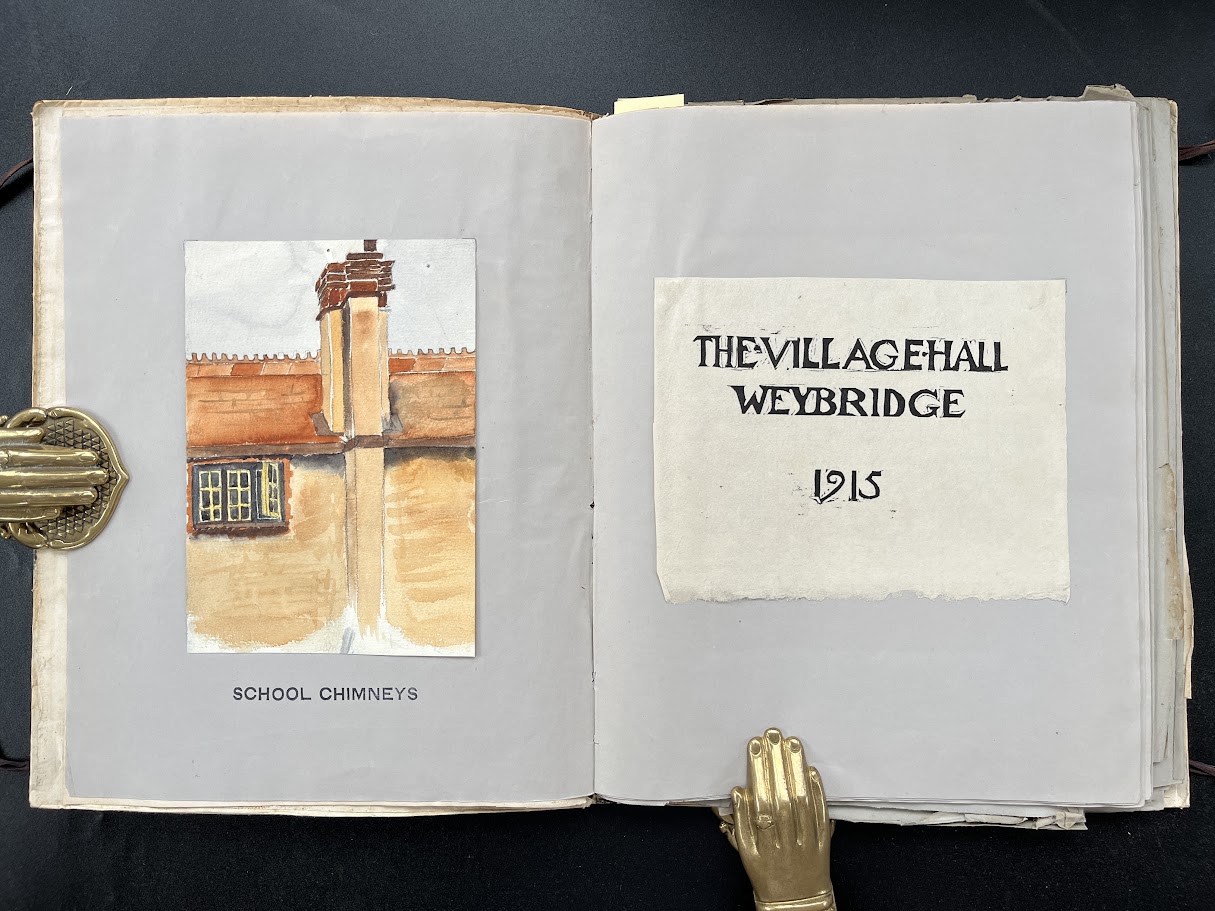
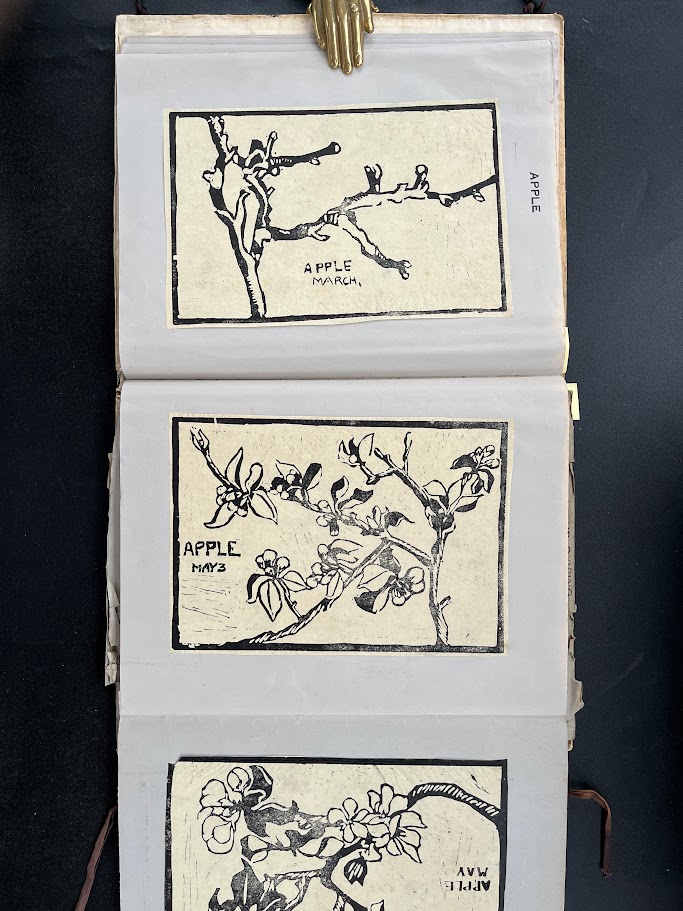
A remarkable educationala experiment and book-making in the form of a collection of lino-cut prints, lithographs, watercolours, woodblock prints and accompanying text which was created by the ground breaking educationalist Eva Margaret Gilpin and her school’s gifted art teacher, Miss E Cassels Gillespy.
Under the sponsorship and protection of Sir Michael Sadler (later the husband of Eva Gilpin) the school was likely the first in England to put linoleum and tools into the hands of its pupils: ‘Miss Gilpin and I saw the work at an Educational Conference at Leipzig in 1908 or 1909; she said, ‘Can we do it?’, I said ‘Yes’, and we started. We made tools out of umbrella spokes … We had carving tools shortened and set in engravers’ handles’ (E Gillespy).
The preliminaries list the names of the 31 contributors followed by sections titled ‘On the Making of the Book’, ‘ A Schoolroom’, ‘Singing’, ‘Little Ones Artwork’, ‘Gymnastics’, ‘Gardening’, ‘Arithmetic’, ‘Pond dipping’, ‘Our Pets’, ‘Stencilling’, ‘Cricket’, ‘Pear’, ‘Net Ball’, ‘Napoleon’ and ‘Dalcroze’.
Eva Gilpin began in Ilkley, Yorkshire, as governess to Michael Sadler’s children before the household moved to Weybridge where she founded The Village Hall School. Attended by Sadler’s son in Weybridge Village Hall the decorations on the walls included a painting by Paul Gauguin (The Vision after the Sermon, on loan from Sadler). Miss E Cassels Gillespy was a practising artist herself with a studio in Cobham and introduced the pupils to the wide range of illustrative techniques, which the contents of the book exemplify.
Four institutional copies of the book survive (The British Library, The University of Leeds and The University of Melbourne) and from its labour-intensive construction it seems unlikely that more than a couple of dozen can ever have been created.
PHYSICAL DESCRIPTION: Vernacular stitched card binding held together by a thick flat dark ribbon which threads through punched eyelets to top and tail securing the spine and contents. Paper covers a little age toned; titled in bold black font with decorative chequered pattern to tail of upper. Cream endpapers good; toned as expected. Contents pasted onto blue leaves many of which fold out containing up to six sections. Occasional leaves a little scuffed to fore edges. One fold out section to rear cracked and sits loosely within binding. All very clean and unmarked throughout. Measures 24cm x 30cm.